Taj Mahal Entry Fee for Foreigners (Complete Guide)
13 May 2025

Choosing the correct Taj Mahal entrance gate may look like a minor detail when arranging an Agra visit, but it can affect how smoothly the morning begins. The Taj Mahal complex has historically been associated with three main gates—the East Gate, West Gate and South Gate—but tourists should not assume that all three currently function in exactly the same way for visitor entry. Entry arrangements, security procedures and gate operations can change, making it important to check the current system before arriving.
For most foreign tourists, the real choice is usually between the Taj Mahal East Gate and West Gate. Both lead visitors into the protected Taj Mahal complex, but their location, approach, surrounding areas and crowd patterns can differ. The most convenient option often depends on where the traveler is staying in Agra, the time of the visit and how transportation has been arranged.
The South Gate of the Taj Mahal creates additional confusion because travelers frequently see it marked on maps or mentioned in older articles. It remains an important physical gateway connected with the historic complex, but tourists should not automatically assume it is available as a normal public entry gate under current arrangements. Visitors should verify the latest official access rules rather than relying on an old blog or map.
Another important detail is that a private car cannot simply drive directly to the marble monument. Vehicle restrictions operate around the protected Taj Mahal zone. Depending on the approach being used, tourists complete the final section using authorized transport arrangements or by walking.
This matters particularly for families with children, elderly visitors and anyone with limited mobility.
A visitor staying close to the East Gate may gain nothing by traveling across Agra simply because another traveler online recommended the West Gate. Similarly, a hotel close to the western side may make the West Gate much more practical.
The best gate for Taj Mahal is therefore usually the one that combines convenient access, current visitor operations and sensible crowd management for the specific trip.
India Agra Tours can arrange a private Taj Mahal visit with hotel pickup, chauffeur-driven transportation and a local guide who can select the practical approach according to the hotel location, visiting time and current gate arrangements.
The East Gate of the Taj Mahal is one of the principal entrances used by tourists and is particularly convenient for travelers staying around the eastern side of Agra and the Taj East Gate area. Many hotels and accommodation options used by international visitors are located on this side, which can make the East Gate a natural choice.
For an early morning visit, convenience becomes especially important.
A traveler waking before sunrise does not usually benefit from adding an unnecessary drive across the city merely to use another gate. If the hotel is already close to the eastern approach, entering from this side can simplify the entire morning.
The East Gate is frequently used for organized private tours as well. A driver can take visitors as close as permitted under the current traffic restrictions, after which the final approach is completed according to the local visitor transport system.
Because motor vehicles are restricted close to the Taj Mahal for environmental and security reasons, tourists should not interpret "hotel pickup" as meaning that the car will stop directly beside the main mausoleum. There is still an approach, security check and walk through the entrance area before the famous first view appears.
For foreign visitors, this is worth knowing before the morning begins.
Someone expecting to step directly from an air-conditioned car into the monument may underestimate the amount of walking involved.
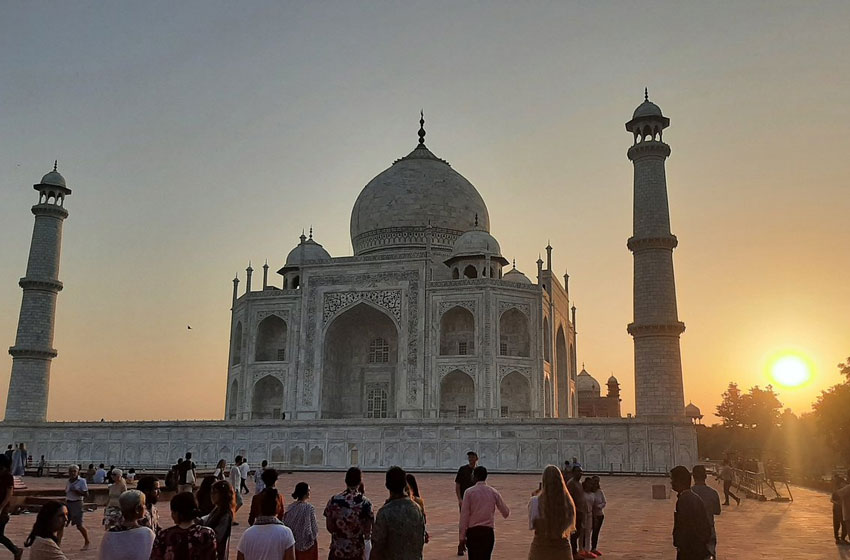
The Taj Mahal East Gate at sunrise can become busy because sunrise is one of the most popular visiting periods. Being at the gate early is therefore more important than debating endlessly about which entrance is theoretically faster.
Security screening is compulsory regardless of the gate used. Visitors should carry only necessary items and avoid prohibited objects that can slow the process.
A small day bag is much easier to manage than a large backpack.
Travelers should also have their valid entry ticket and required identification available according to the current ticket rules. Buying an online ticket before reaching the entrance can reduce unnecessary delays, particularly during busy travel periods.
The East Gate does not provide a different Taj Mahal once the visitor is inside. Both principal visitor approaches ultimately lead into the same monument complex. The difference lies primarily in how convenient the approach is for the individual traveler.
The Taj Mahal West Gate is another principal visitor entrance and is particularly convenient for travelers approaching from the western side of the monument.
Historically, the West Gate has been a heavily used entrance. Domestic visitors, tour groups and independent travelers may all use this side, and crowd levels can become significant during popular periods.
That does not mean the West Gate should automatically be avoided.
If a traveler's hotel, driver route or previous sightseeing location makes the western approach more convenient, using this gate can still be the most efficient choice.
Crowds at the Taj Mahal are dynamic.
A gate that appears quiet in one traveler's experience may be busy on another day because of weekends, public holidays, tour-group arrivals or seasonal tourism demand. Foreign visitors should therefore avoid treating statements such as "the East Gate is always empty" or "the West Gate always has huge queues" as fixed rules.
The West Gate of Taj Mahal at sunrise can work perfectly well when the traveler arrives early and has the ticket ready.
The practical objective is to reach security before large numbers of visitors accumulate.
During the main winter tourism season, both major entrances can experience demand. Christmas and New Year dates, weekends and important Indian holiday periods can be particularly busy.
The West Gate also has its own approach area, and private vehicles remain subject to restrictions around the protected monument zone.
Visitors traveling with a local guide have an advantage because the guide can help identify the correct approach and security line rather than leaving the traveler to interpret multiple signs while surrounded by other visitors.
This is particularly helpful for first-time foreign tourists who may already be tired after an early start.
The West Gate is therefore not a "bad gate." It is simply another major entrance whose usefulness depends on location and conditions.
The Taj Mahal South Gate causes more confusion than either the East or West Gate.
Older travel material and maps may describe three gates in a way that makes them appear equally available for normal tourist entry. That should not be assumed.
The South Gate is physically part of the historic Taj Mahal complex and is associated with the area toward Taj Ganj, but visitor access arrangements have changed over time. Under recent operating arrangements, tourists should not depend on the South Gate as their normal entrance without first checking its current status.
This distinction is important because a traveler could otherwise book accommodation or arrange transportation based on outdated information.
The South Gate area remains historically interesting, but the practical tourist entrances are generally discussed in terms of the East and West Gates.
Travelers should therefore use current official information when deciding which Taj Mahal gate to enter, especially if they are visiting independently without a guide.
The same principle applies to opening hours and ticketing. The Taj Mahal is a protected monument with security requirements, and operating procedures can be revised.
A blog written several years earlier may accurately describe what happened at that time but no longer represent current visitor operations.
For this reason, India Agra Tours checks practical local arrangements when coordinating private visits rather than telling every traveler to use the same gate regardless of hotel location.
Sunrise is one of the most requested times for visiting the Taj Mahal, and travelers often spend too much time worrying about whether the East Gate or West Gate is better for Taj Mahal sunrise.
In practice, arriving early matters more.
The Taj Mahal generally opens around sunrise, with actual timing connected to seasonal daylight and current monument operations. Visitors wanting an early entry should be at the appropriate gate before opening rather than arriving at the stated opening time and then beginning the security process.
If a traveler is staying near the East Gate, the East Gate is usually the logical option.
If the hotel or pickup point makes the West Gate considerably easier, crossing the city just to use the East Gate may add unnecessary travel.
Crowds can occur at either entrance.
During high-demand periods, tour groups and independent visitors begin arriving before opening. Once the security process starts, prohibited belongings or visitors who are unprepared can also affect queue movement.
Carrying only essential permitted items can therefore save more time than changing gates.
Winter creates another consideration.
December and January mornings in Agra can be cold, and fog may occasionally reduce visibility. Standing outside for an excessive amount of time simply to be among the first few people through the gate may not be worthwhile for every traveler, particularly elderly visitors.
Sunrise is beautiful when conditions cooperate, but a Taj Mahal sunrise tour should not become physically uncomfortable simply for the sake of entering a few minutes earlier.
During warmer months, early entry has a stronger practical advantage because temperatures rise later in the day.
For photographers, early morning also provides softer light and the possibility of fewer people in certain photographs, although completely empty Taj Mahal photographs should never be guaranteed.
The monument is internationally famous. Other visitors will be there.
There is no separate Taj Mahal entrance that every foreign tourist must use simply because of nationality.
The best Taj Mahal gate for foreign tourists depends primarily on the traveler's location, current entry system and visiting time.
Foreign visitors often stay around Fatehabad Road, Taj East Gate Road or other hotel areas used heavily by international tourism. Depending on the exact property, the East Gate can be convenient.
Travelers arriving directly from another part of Agra may find the West Gate easier.
A private guide can decide according to the day's circumstances rather than following a rigid rule.
Foreign tourists should also remember that ticket categories are different from gate selection. International visitors normally purchase the applicable foreign tourist ticket, but that does not automatically mean there is one exclusive gate they must use.
Security remains compulsory.
Passports or other appropriate identification should be carried according to current ticket requirements. Travelers should also ensure that the nationality selected when buying a ticket matches the applicable ticket category.
The Taj Mahal ticket price for foreign visitors has commonly been around ₹1,100 for basic monument entry, with approximately ₹200 additional access for the main mausoleum. Since official rates can be revised, visitors should check the current price before purchasing rather than relying on an old travel article.
The main mausoleum supplement is separate because visitors who only want to see the gardens and exterior of the Taj Mahal do not necessarily require access to the interior mausoleum.
Families should purchase the correct tickets in advance where possible so that the gate experience is focused on security and entry rather than last-minute confusion.
For a traveler with limited mobility, Taj Mahal gate selection should be based on minimizing unnecessary physical effort.
The question is not simply which queue is shorter.
The distance from the hotel, vehicle drop-off arrangement, final approach and availability of mobility assistance all matter.
A family staying close to the East Gate may find that approach significantly easier. Another family arriving from a different part of Agra may be better served by the West Gate.
Older travelers who can walk independently in everyday life may still find the Taj Mahal tiring. The complex is large, and the visitor must account for the approach, security line, gardens, main platform area and return journey.
Using a wheelchair for part of the visit can conserve energy.
Families who require wheelchair assistance should confirm the current facility before arrival rather than assuming equipment will automatically be waiting at whichever gate they choose.
A private guide can also help keep the visit at a realistic pace.
Elderly visitors do not need to race directly from the gate to the marble platform. The central garden contains famous views of the monument, and stopping periodically can make the experience much more enjoyable.
Temperature should influence entry time as well.
During hot weather, an early morning entrance is generally easier for senior visitors. During December and January, extremely early arrival can mean standing outside in cold conditions, so a slightly later entry may be more comfortable.
There is no benefit in selecting the "fastest" gate if the elderly traveler reaches the monument already exhausted.
Every visitor passes through security before entering the Taj Mahal, making baggage preparation an important part of choosing a smooth entry.
The Taj Mahal has strict rules about items permitted inside the protected complex. Security regulations can be updated, so visitors should check the current official list before arriving.
The safest approach is to carry as little as possible.
A phone, camera where permitted, necessary identification, ticket and a few essential personal items are much easier to manage than a large travel bag.
Foreign tourists arriving directly from another city should avoid taking all of their luggage to the monument entrance. Suitcases should remain at the hotel or in another secure permitted arrangement rather than becoming part of the monument visit.
Items that raise security concerns can cause delays or be refused.
Food, tobacco products, potentially hazardous items and other restricted objects should not be carried into the monument. Professional photographic equipment may also be subject to specific regulations.
Visitors should never assume that because an item was allowed at another Indian monument it will automatically be accepted at the Taj Mahal.
Security rules are specific to the site.
A private Taj Mahal guide can remind travelers what should remain in the vehicle before they approach the gate, preventing the frustrating situation of reaching security and having to return to dispose of or store an item.
This small preparation can make a bigger difference to entry time than obsessing over East versus West Gate.
For a sunrise visit, reaching the gate before the monument opens is sensible.
Exactly how early depends on the season, expected crowds and visitor preference. During popular periods, arriving approximately 30 to 45 minutes before expected opening can provide enough time to get into position for the security process.
Travelers seeking a relaxed visit do not necessarily need to arrive extremely early.
If photography without heavy crowds is the priority, earlier is generally better. If an elderly traveler values warmth and comfort more than being among the first entrants, arriving slightly later may make sense.
For daytime visits, the visitor should consider temperature.
Between late spring and early summer, the middle of the day can be extremely hot. Morning visits are usually more comfortable.
During winter, late morning can offer warmer conditions than sunrise, although crowds may be greater.
Late afternoon is another attractive period because the light becomes softer as sunset approaches.
However, visitors must allow enough time before closing. Arriving too close to sunset can result in a rushed visit.
The Taj Mahal deserves at least two to three hours for most first-time visitors who want to walk through the gardens, photograph the monument and spend time near the main mausoleum.
Choosing a gate is therefore only the beginning of the visit.
Hotel location is one of the most practical ways to determine which Taj Mahal gate is best.
Visitors staying around Taj East Gate Road naturally have convenient access to the eastern approach.
Travelers staying elsewhere in Agra may find the West Gate more efficient.
A good private tour should not force every guest to use the same entrance simply because it is the tour company's usual routine.
Agra traffic can vary according to time and location. Driving across the city unnecessarily adds time before a visit that already involves substantial walking.
This becomes even more important at sunrise.
If a traveler has woken early, the objective should be to reach the appropriate entrance efficiently, not spend additional time in a vehicle reaching a gate on the opposite side of the complex.
Hotel selection can therefore influence the entire Taj Mahal experience.
Foreign travelers booking a hotel specifically because they want a sunrise visit may find accommodation around the East Gate area convenient. Some properties in this area are positioned within relatively easy reach of the monument's visitor approach.
Travelers should still check the exact distance rather than trusting phrases such as "near the Taj Mahal" in hotel advertising.
A property may technically be in the Taj Mahal area while still requiring transportation to the gate.
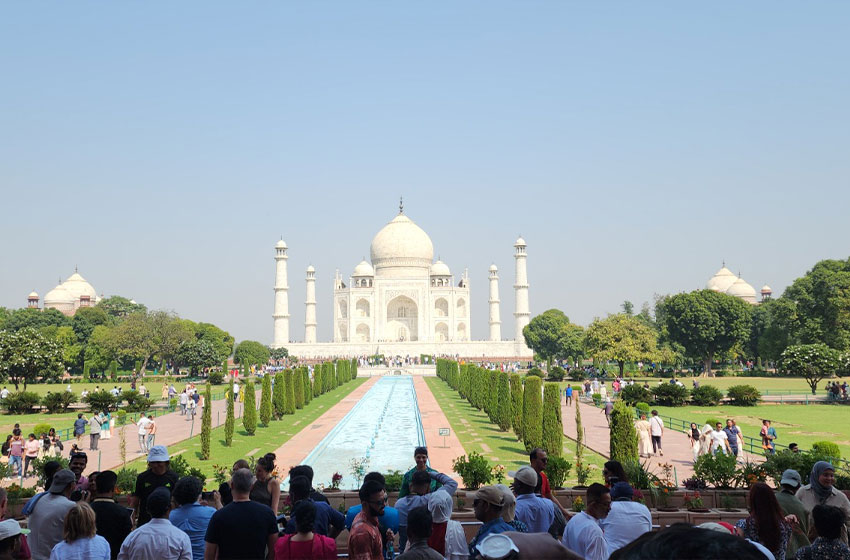
Once security has been completed, visitors move through the outer areas toward the monumental gateway leading into the main Taj Mahal garden.
This is where gate choice becomes much less important.
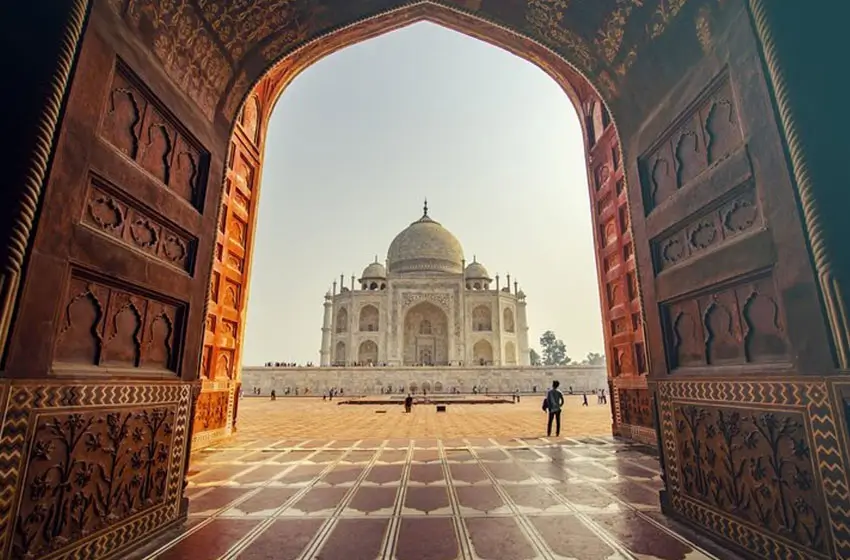
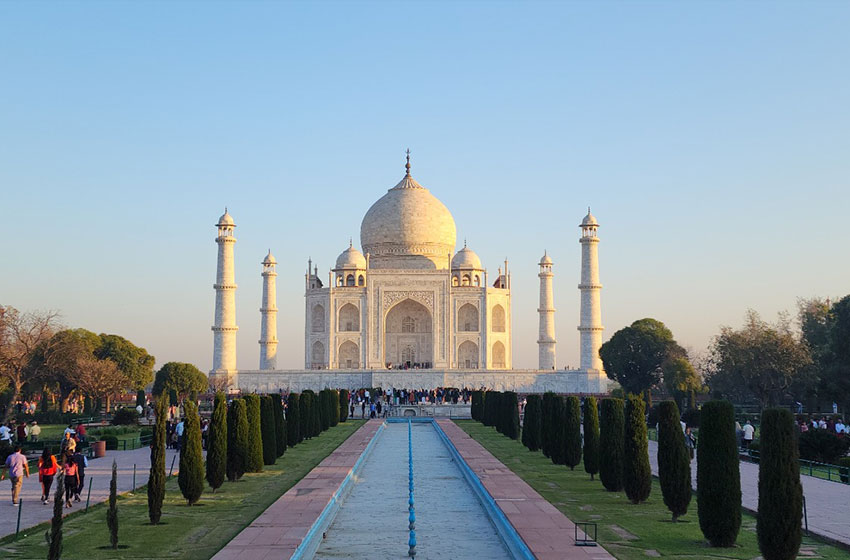
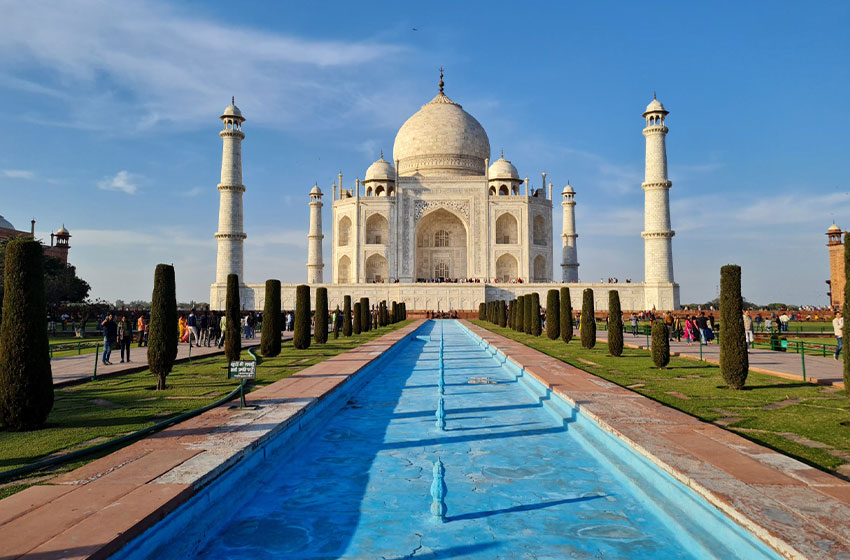
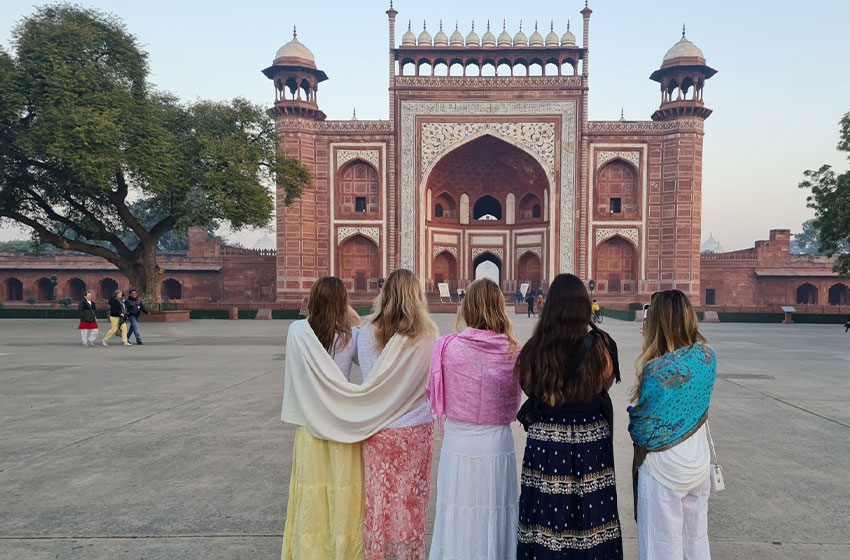
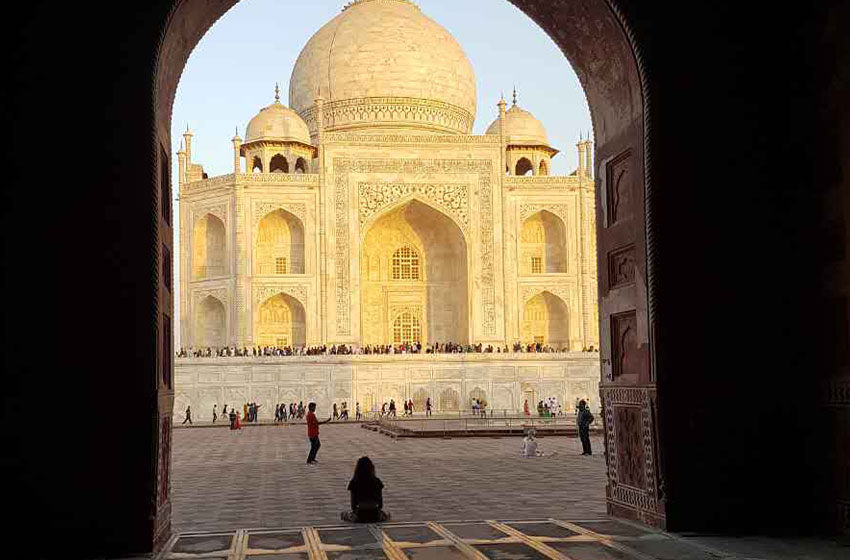
The famous moment occurs when visitors pass through the grand red sandstone gateway and the white marble Taj Mahal appears framed through the arch.
From there, the main garden stretches toward the mausoleum.
Visitors can walk along the central axis, stop around the reflecting pools and photograph the Taj Mahal from several positions before moving closer.
The complex should not be treated as a straight race to the mausoleum.
Some of the best photographs are taken from the garden, where the monument's symmetry can be appreciated properly.
As visitors move closer, the scale becomes more obvious. What looks delicate from the main gateway becomes enormous at the marble platform.
Travelers who have purchased the additional mausoleum ticket can proceed according to the current visitor route.
Once inside the complex, everyone is sharing essentially the same Taj Mahal experience regardless of whether they originally arrived through the East or West Gate.
That is why the gate decision should remain practical rather than becoming a major source of anxiety.
For a same-day Taj Mahal tour from Delhi, the correct entrance should be selected according to arrival route, traffic and the day's schedule.
A private driver normally collects travelers from their Delhi hotel or airport and drives to Agra. Once approaching the Taj Mahal zone, the guide and driver can coordinate the most practical drop-off arrangement.
Travelers do not need to decide months in advance that they must use one specific gate.
The local situation on the day can determine the better approach.
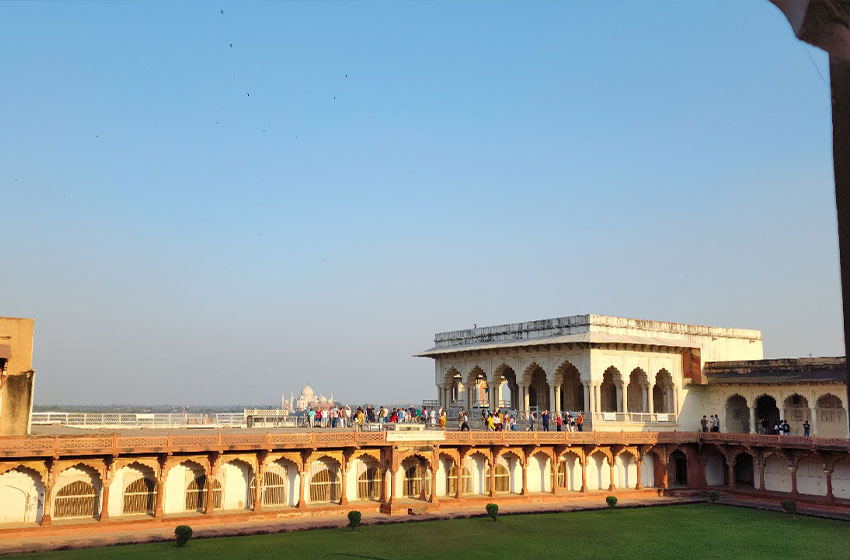
After the Taj Mahal, a same-day tour can continue to Agra Fort, followed by lunch and another suitable attraction if sufficient time remains.
Visitors interested in sunset can include Mehtab Bagh before returning to Delhi, although the day becomes considerably longer.
An overnight stay in Agra provides more flexibility for travelers wanting sunrise.
India Agra Tours can arrange a private Delhi to Agra Taj Mahal tour by car, including hotel pickup, private chauffeur transportation and a local Agra guide. The appropriate Taj Mahal entrance can be selected according to the hotel or arrival route rather than forcing visitors into a fixed gate.
For most visitors, the East Gate or West Gate is the practical choice. The best one depends on hotel location, current crowd conditions and transportation arrangements rather than one gate always being superior.
The East Gate can be very convenient for travelers staying around Taj East Gate Road and nearby hotel areas. The West Gate can be equally practical for visitors approaching from the western side. Crowd levels vary by day and time.
Visitors should not assume the South Gate currently operates as a normal tourist entrance simply because it appears on older maps or articles. Current access arrangements should be checked before the visit, with East and West generally being the principal tourist entry options.
The best Taj Mahal gate for sunrise is usually the operational gate that is most convenient from the traveler's hotel or pickup point. Arriving early with the correct ticket and minimal baggage is generally more important than choosing East over West.
Reaching the selected gate approximately 30 to 45 minutes before expected opening can be sensible during busy periods. Actual opening is linked to sunrise and current monument operations.
Foreign tourists can use the appropriate operational visitor entrance. There is no need to cross Agra simply because of nationality. Hotel location, crowds and current access arrangements should determine the gate.
The gate that minimizes unnecessary travel and walking is generally best. Families should consider hotel location, drop-off arrangements, wheelchair requirements and the elderly traveler's comfort.
Private motor vehicles are restricted within the protected zone around the Taj Mahal. Drivers take visitors as close as permitted, after which the final approach is completed using the current authorized transport or walking arrangement.
Most first-time visitors should allow approximately two to three hours for the Taj Mahal. Photography, security, garden walking and mausoleum access can increase the total time.
Yes. India Agra Tours can arrange a private Taj Mahal tour with car, driver and local guide. The practical entrance can be selected according to hotel location, arrival route, mobility requirements and current gate operations, allowing travelers to concentrate on the monument rather than managing local entry logistics.