Taj Mahal Entry Fee for Foreigners (Complete Guide)
13 May 2025
Keeping phones, cameras, laptops, power banks and other electronics charged is essential during an India holiday. For international tourists, however, connecting a device to an Indian wall socket is not always as simple as carrying a small plug adapter. Travelers also need to know the country's electrical voltage, frequency and whether their individual devices can safely operate on the local power supply.
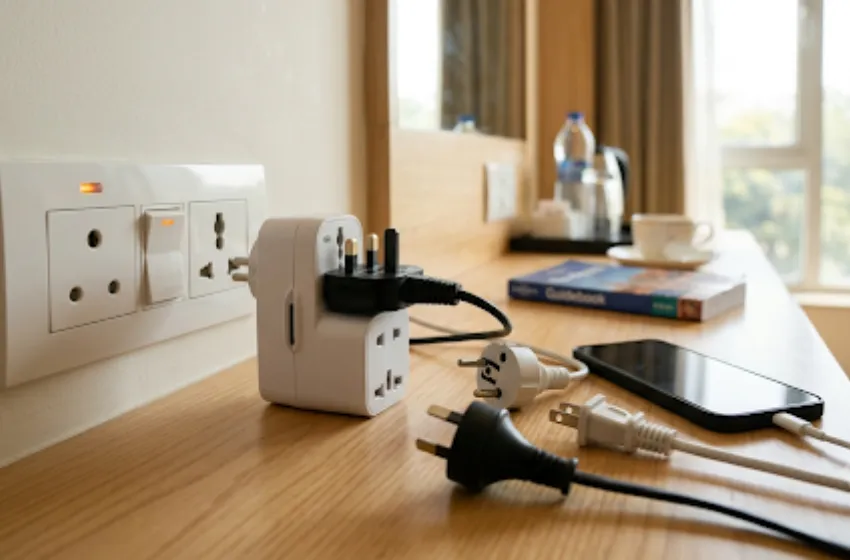
India generally uses 230V electricity at 50Hz, and travelers can encounter Type C, Type D and Type M electrical sockets. Type D, with three round pins arranged in a triangular pattern, is strongly associated with India. Type C uses two round pins and is familiar to many European travelers. Type M is a larger three-round-pin configuration normally associated with higher-current connections and is less important for the ordinary phone and laptop charging needs of most tourists.
The good news is that many modern electronic chargers are designed for worldwide voltage. Phone chargers, laptop power supplies, camera chargers and USB charging adapters often state an input range such as 100–240V, 50/60Hz. When a charger carries this specification, it can generally accept Indian voltage without a separate voltage converter. The traveler may still need a plug adapter so the charger's pins physically fit the wall socket.
The situation becomes more complicated with high-power appliances such as hair dryers, curling irons and straighteners. A device designed only for 110V or 120V should not simply be connected to India's approximately 230V supply using an ordinary plug adapter. A plug adapter changes the physical connection; it does not normally convert voltage.
This distinction is particularly important for travelers from the United States and Canada. Visitors from the United Kingdom, continental Europe and Australia also need to check plug compatibility, but many of their devices are already designed around a nominal supply voltage closer to India's.
This guide explains India plug types for tourists, voltage compatibility, adapters, converters, USB charging, hotel sockets, power banks and what travelers should carry on a multi-city journey through Delhi, Agra, Jaipur and Rajasthan.
Travelers in India can encounter Type C, Type D and Type M plugs and sockets. Type D is one of the most recognizable Indian configurations and has three round pins positioned in a triangular arrangement. Type C has two round pins, while Type M looks somewhat similar to Type D but uses larger round pins.
For an ordinary international tourist, Type D is the most important format to keep in mind when purchasing an India travel plug adapter. However, hotels do not always have only one traditional socket type. Modern hotel rooms frequently use multi-standard or universal-style outlets intended to accommodate guests arriving with different international plugs.
Travelers should not depend completely on universal hotel sockets. Compatibility can vary between hotels and even between rooms within the same property. An older heritage hotel in Rajasthan may have different electrical fittings from a recently built international hotel in Delhi. Carrying a reliable adapter gives the traveler independence from whatever socket happens to be installed beside the bed.
Type C compatibility can also be useful for European travelers, but a plug physically fitting into a socket does not automatically settle every electrical question. The device's voltage rating must still be checked.
Type M is generally less relevant to ordinary travel electronics. Most tourists will not need to purchase a special Type M solution merely to charge phones and cameras. A good travel adapter designed for India and a properly rated charger normally covers the everyday needs of an international visitor.
Experience India with Complete Travel Comfort
Enjoy comfortable accommodation, private transportation and thoughtfully planned sightseeing across India. Prepare your travel essentials in advance and focus on discovering unforgettable destinations.
India's standard electricity supply is approximately 230 volts at 50 hertz. These two numbers matter because electrical devices are designed to operate within specified voltage and frequency ranges.
The easiest way to check a charger is to read the small text printed on the charger body or power supply. A modern charger may say something similar to:
Input: 100–240V ~ 50/60Hz
A charger with that input specification is designed to work across a broad range of international electrical systems, including India's 230V/50Hz supply. The traveler still needs to make sure the plug can connect physically to the Indian socket, but a separate voltage converter is generally unnecessary for that charger.
If the label states only 110V, 120V, or another limited range that does not include approximately 230V, the situation is different. The device should not simply be plugged into an Indian outlet through a basic adapter.
Frequency can also matter for certain equipment. Many electronic power supplies support both 50Hz and 60Hz, which is why their labels state 50/60Hz. Some appliances with motors or timing mechanisms can be more sensitive.
The safest rule is simple: check the actual electrical label of every important device rather than assuming compatibility based on where the device was purchased.
This is the most important electrical distinction for foreign tourists visiting India. A plug adapter for India changes the shape of the electrical connection so a foreign plug can fit an Indian socket. It normally does not change 230V electricity into 120V electricity.
A voltage converter or transformer, by contrast, changes the electrical voltage supplied to a device. Whether a converter is suitable depends on the appliance, its wattage and the converter's design.
Suppose an American traveler has a phone charger labeled 100–240V, 50/60Hz. The charger already accepts Indian voltage, so the traveler generally needs only a physical plug adapter. There is no need to convert 230V to 120V for that charger.
Now consider an appliance labeled only 120V. A simple adapter may allow its plug to fit the wall, but the device is still receiving approximately 230V. This can damage the appliance and may create a safety hazard.
Travelers should never assume that a product advertised as a "travel adapter" automatically converts voltage. Many popular universal travel adapters do not. The product specification should clearly state whether voltage conversion is included.
For most modern phones, tablets, laptops and camera chargers, voltage conversion is often unnecessary because their power supplies are already dual-voltage or universal-voltage. High-power personal-care appliances require much greater attention.
Yes, travelers from the United States should normally carry an India power adapter for US plugs. Standard American Type A and Type B plugs are physically different from India's traditional Type D sockets, so an adapter is needed when a universal hotel outlet is not available.
Voltage is the more important issue. The United States commonly uses a supply around 120V, while India uses approximately 230V. An American traveler must therefore check every device before connecting it.
Most modern smartphone and laptop chargers are designed for 100–240V operation. If the charger's input label confirms this range, the device normally needs only a plug adapter. Apple, Samsung, Google and other modern electronics commonly use internationally compatible power supplies, but the label on the actual charger should always be treated as the final reference rather than the brand name alone.
Hair dryers, curling irons, electric shavers and similar appliances need more attention. Some are dual-voltage; others are not. A device marked only 110–120V should not be connected directly to an Indian socket using only a plug adapter.
US visitors should check devices before leaving home. Doing this at the packing stage is much easier than attempting to read tiny electrical specifications after arriving at a hotel late at night.
Canadian travelers face a situation similar to visitors from the United States because Canada also commonly uses Type A and Type B plugs and a nominal electrical supply around 120V.
A Canada to India plug adapter is therefore normally required unless the hotel provides a universal outlet that accepts the Canadian plug directly. Even when such an outlet is available, voltage compatibility still matters because the socket supplies Indian electricity.
Phone, tablet, camera and laptop chargers frequently support 100–240V and can therefore work safely with Indian voltage when their labels confirm the appropriate range. High-wattage personal appliances should be checked individually.
Canadian travelers carrying medical devices should pay particular attention to manufacturer specifications. Equipment such as CPAP machines may have internationally compatible power supplies, but this should never be assumed. The device manual or manufacturer information should confirm the supported voltage and frequency.
Anyone relying on powered medical equipment should also consider what happens during a short electricity interruption and whether an appropriate backup solution is recommended by the manufacturer.
The important principle is that plug shape and voltage are two separate questions. Solving the plug-shape problem does not automatically solve the voltage issue.
Travelers from the United Kingdom usually need a physical adapter because the UK's Type G plug has three rectangular pins, while India's traditional Type D socket uses round pins.
The voltage issue is generally simpler than for American visitors because the UK also uses a nominal supply around 230V at 50Hz. Many ordinary UK electrical devices are therefore designed for a voltage and frequency compatible with India.
However, physical plug compatibility still needs to be solved. A UK to India travel adapter is a useful item even when a hotel advertises universal electrical sockets. Carrying at least one adapter prevents the traveler from depending on a particular room configuration.
UK tourists should still read the device label rather than assuming every appliance is automatically suitable. Electronics can have specialized power requirements regardless of the country where they were purchased.
A universal adapter with USB ports can be particularly convenient for a couple carrying several devices. One wall connection can support phone charging while the main AC outlet remains available for a laptop or camera charger, provided the adapter is used within its stated electrical limits.
For a multi-city Rajasthan road trip, having a personal adapter is particularly helpful because room sockets can vary between heritage properties, modern hotels and desert accommodation.
Get Ready for Your Indian Adventure
Travelling from the US, UK, Europe or Australia? Prepare your electronics, check device compatibility and organise essential accessories before exploring India's incredible destinations.
Travelers from continental Europe may find some Indian sockets physically compatible with their two-round-pin plugs because Type C sockets and plug compatibility can be encountered in India. However, travelers should not assume every hotel room will accept every European plug perfectly.
European Type C plugs are generally straightforward, but larger Type E or Type F plugs may not fit every socket. A compact universal travel adapter therefore remains useful even for visitors whose ordinary phone charger works in some Indian outlets without one.
Most European countries use electricity around 230V and 50Hz, making voltage compatibility relatively simple for many European devices. Nevertheless, the appliance label should still be checked, particularly for specialist equipment.
Loose socket fit is another practical consideration. A plug that technically enters a multi-standard outlet may not sit securely enough to maintain charging. A proper adapter can sometimes provide a more reliable connection.
Travelers visiting several countries on the same holiday may prefer one high-quality universal adapter instead of carrying separate adapters for each destination. The product should explicitly support the countries and plug configurations on the itinerary.
A Europe to India plug adapter is therefore not always necessary for every individual socket, but carrying one remains sensible.
Australian Type I plugs, with angled flat pins, do not match India's traditional Type D sockets. Australian visitors should therefore carry an Australia to India power adapter or a universal travel adapter that supports Indian outlets.
Australia's nominal voltage is close to India's, and both systems use 50Hz electricity. This means many Australian devices are electrically compatible from a voltage perspective, but travelers should still check the manufacturer's input label.
Phone and laptop chargers usually create few difficulties when they support the expected voltage range. Personal-care appliances and specialist electronics should be checked individually.
Australian travelers often take longer international holidays and may be carrying adapters for several countries. A universal adapter can simplify luggage when the journey includes India together with destinations using different socket types.
As with visitors from other countries, relying only on universal hotel sockets is not ideal. A personal adapter ensures charging remains possible at smaller heritage hotels, safari lodges and other accommodation where outlet designs may differ.
Most modern iPhone charging adapters are designed for international voltage ranges, but travelers should check the actual charger being carried. If the input label includes 100–240V and 50/60Hz, it can accept India's approximately 230V/50Hz electrical supply.
The remaining issue is plug shape. A US iPhone charger, for example, still has American-style pins and therefore requires a suitable adapter when the hotel outlet does not accept them. A European charger may fit certain Indian sockets directly, although carrying an adapter remains useful.
Travelers using USB-C charging can simplify their electronics considerably. A good multi-port charger with an appropriate international input rating can charge an iPhone, iPad, power bank and other USB devices from one wall outlet.
Tourists should be careful with very cheap, unbranded electrical adapters purchased without clear safety specifications. A poor-quality adapter can fit loosely, become hot or provide unreliable connections. A reputable product with suitable electrical ratings is preferable for expensive electronics.
Anyone carrying multiple Apple devices should also remember that a plug adapter does not increase the number of outlets. A multi-port USB or USB-C charger can be more useful than packing several individual charging bricks.
Modern Android phone chargers from major manufacturers frequently support international voltage, but the actual charger's input rating should be checked. If it states 100–240V, 50/60Hz, it is designed to accept India's electrical supply.
The physical plug still needs to fit. A Samsung, Google, OnePlus or other charger purchased in the United States may require an adapter, while a European two-pin charger may work with certain outlets more easily.
Fast charging can continue to work when the original charger is used with a suitable plug adapter because the adapter itself does not normally alter the charger's charging protocol. However, the adapter must be appropriately rated and make a secure electrical connection.
Travelers using a replacement or third-party charger should check that charger's specifications instead of assuming compatibility based on the phone model. The electrical characteristics belong to the power supply, not simply to the phone.
A universal travel adapter for India with USB-C can be convenient, but visitors who depend on very fast proprietary charging may prefer to bring the phone's original charger and use a simple plug adapter.
Most modern laptop power supplies are designed for international use. Apple MacBook chargers and many Windows laptop power adapters commonly support 100–240V, 50/60Hz, although the label on the individual power supply should always be checked.
When the power supply accepts this range, a traveler normally needs only a physical plug adapter. The laptop itself receives the lower controlled voltage supplied by its charging brick rather than being connected directly to the wall voltage.
Business travelers should consider carrying more than one charging option if the laptop is essential for work. A suitable USB-C charger can sometimes serve both laptop and phone, reducing the number of separate power supplies in the luggage.
Hotel desks do not always have conveniently positioned outlets. In some rooms, the nearest socket may be beside the bed or behind furniture. A compact extension solution can be useful, but any extension device must be properly rated for 230V use and should not be overloaded.
Visitors should never use a damaged adapter, loose plug or cable with exposed wiring. If a hotel outlet appears damaged or unusually loose, request another outlet or contact hotel staff rather than forcing the connection.
Camera battery chargers generally work well in India when they support 100–240V input. Photographers should check every charging unit because a dedicated battery charger may have different specifications from the USB charger used for a phone.
A traveler carrying several camera batteries may want a dual-battery charger, particularly on a Taj Mahal and Rajasthan photography tour. Sunrise photography often begins before breakfast, while long sightseeing days may continue until sunset. Charging two batteries simultaneously overnight can therefore be valuable.
Wildlife photographers visiting Ranthambore should pay particular attention to battery management. Morning and afternoon safaris can create heavy camera use, and returning to the hotel with several depleted batteries can create a queue for limited wall sockets.
A multi-port USB charger can help when cameras support USB charging. For cameras requiring a dedicated AC charger, a universal adapter with an appropriate pass-through outlet may be useful.
Photographers should also pack spare batteries in accordance with airline regulations. Lithium battery rules can differ for checked and cabin baggage, so current airline requirements should be checked before flying.
Personal-care appliances are where voltage mistakes most commonly become expensive. Hair dryers, straighteners and curling irons can draw significantly more power than a phone charger and may not support worldwide voltage.
An American 120V hair dryer in India should not be connected to a 230V wall supply using only a plug adapter. The adapter changes the pin shape but does not reduce the voltage. Doing this can damage the appliance and create a safety risk.
Some travel hair dryers and styling tools have dual-voltage settings, often marked with two voltage ranges. The traveler must make sure the appliance is switched to the correct setting before use. Manufacturer instructions should be followed carefully.
Voltage converters designed for high-wattage heating appliances can be bulky, and not every converter works with every hair tool. Travelers should compare the appliance wattage with the converter's rated capacity before considering this approach.
For many visitors, the simplest solution is to use the hair dryer provided by the hotel. Mid-range, upscale and luxury hotels commonly provide one in the room or on request. This eliminates the need to carry a heavy appliance and removes the voltage problem entirely.
Make Your India Travel Packing Stress-Free
Pack smarter with essential travel accessories, compatible chargers and practical everyday items. Prepare before departure and enjoy greater convenience throughout your sightseeing, transfers and hotel stays.
Electric shavers and toothbrush chargers vary widely. Some modern models support 100–240V input, while others use charging bases or specialized adapters with more limited specifications.
Travelers should check the label on the charger rather than the appliance itself when the device connects through a separate power supply. If the charging unit supports 230V/50Hz, only a plug adapter may be required.
A toothbrush with a long battery life may not need charging at all during a short Golden Triangle holiday. Fully charging it before departure can eliminate one device from the nightly charging routine.
Shavers can present a similar situation. A rechargeable model with enough battery capacity for a one- or two-week trip is much simpler than carrying additional electrical equipment.
Visitors staying in multiple hotels should keep small charging accessories together in one pouch. Tiny adapters and proprietary charging cables are easy to leave behind when packing quickly for an early road departure.
A useful universal travel adapter for India should clearly state that it supports the plug types required for the traveler's itinerary and should be appropriately rated for India's voltage. Travelers should choose a product from a reputable manufacturer rather than selecting the cheapest adapter solely because it claims compatibility with many countries.
Multiple USB-A or USB-C ports can be valuable for couples and families because hotel rooms do not always provide enough convenient sockets for every device. A single quality adapter with several charging ports can reduce the number of wall adapters needed.
USB-C Power Delivery is useful for modern phones, tablets and compatible laptops, but travelers should check the charger's maximum output. A port capable of charging a phone is not automatically powerful enough to charge every laptop at full speed.
The adapter should also have appropriate safety features and clear electrical ratings. Travelers should not connect appliances that exceed its maximum current or wattage.
Remember that most universal travel adapters are not voltage converters. Even a sophisticated adapter with several USB ports may pass the local wall voltage directly through its AC outlet. Any appliance connected to that outlet must therefore be compatible with India's supply.
For a solo traveler carrying only a phone and camera, one reliable adapter may be sufficient. For a couple carrying two phones, a laptop, camera batteries, watches and power banks, a second adapter can make evenings much easier.
Hotel rooms sometimes have several sockets but only one conveniently positioned outlet. Another socket may be used by a lamp, television or minibar. Having two adapters provides flexibility without constantly unplugging one device to charge another.
A multi-port USB charger can reduce the need for multiple adapters. For example, one properly rated charger may handle two phones, a smartwatch and a power bank while a second wall adapter is used for the laptop or camera battery charger.
Travelers moving every day should also consider redundancy. Losing the only adapter on the second day of a two-week Rajasthan journey creates unnecessary inconvenience. A small spare takes little luggage space.
For a 7-day or 14-day India tour, two compact adapters or one adapter plus a quality multi-port charger is a sensible arrangement for travelers carrying several electronic devices.
Many hotels serving international guests have universal electrical sockets capable of accepting several foreign plug types. These are particularly common at upscale hotels, international chains and newer properties in major tourist cities.
However, travelers should not rely on them completely. A universal outlet can be worn or loose after years of accommodating many plug shapes. A heavy charger may fall out or lose contact. Some rooms may also have only one universal socket while other outlets use Indian configurations.
Heritage hotels present another variable. A beautifully restored palace or haveli may have modern electrical systems but fewer conveniently positioned outlets than a contemporary business hotel. Guests carrying many devices can find charging space limited.
Desert camps and smaller properties may have simpler arrangements. Electricity availability can also differ according to the property, particularly in more remote accommodation.
Carrying your own India electrical adapter remains the safest solution even when every hotel on the itinerary is high quality. The adapter is small, inexpensive relative to the holiday and prevents a simple socket difference from becoming a daily problem.
Higher-quality Jaisalmer desert camps generally provide electricity for guest tents or rooms, but travelers should confirm the exact arrangements before arrival. Some remote properties may have limited outlet availability, generator-backed electricity or specific periods when certain electrical services operate.
Guests carrying cameras and phones should charge important devices before leaving the Jaisalmer city hotel whenever possible. A fully charged power bank provides additional backup for the desert evening.
Travelers should not assume that a tent marketed as luxury automatically contains multiple bedside USB sockets. Ask whether the accommodation has an electrical outlet inside the tent, what type it is and whether charging is available throughout the night.
High-power appliances should be avoided when the property's electrical system is limited. A hair dryer can draw far more electricity than a phone charger and may not be suitable for every camp setup.
A Jaisalmer desert tour for foreign tourists usually involves extensive phone and camera use around sunset, so arriving with fully charged batteries is much more reliable than depending entirely on camp charging facilities.
Some modern tourist vehicles have USB charging ports or 12V accessory sockets, but travelers should not assume every private car provides high-speed charging for several devices. Vehicle charging is best treated as a useful backup rather than the primary charging method for an entire trip.
A USB port built into a vehicle may charge more slowly than a modern wall charger. Navigation, photography and mobile data can also consume significant battery during long travel days, so connecting the phone during road transfers can still be helpful.
Travelers using a 12V car charger should bring a quality device compatible with their phone. Drivers may have a charger available, but relying on someone else's cable is unnecessary when personal charging accessories take very little luggage space.
A power bank is even more flexible because it works inside the car, at monuments and during walks. It also avoids competing for the vehicle's single charging socket when several passengers need power.
On a Rajasthan tour by private car, road sectors such as Jaipur to Jodhpur and Jodhpur to Jaisalmer can last around five or six hours. These drives provide a useful opportunity to recharge phones before reaching the next destination.
A power bank for India travel is highly useful. Phones are used for photography, messaging, maps, translation, tickets and communication with hotels or drivers, so battery consumption can be much higher during travel than at home.
A power bank is particularly valuable during a Taj Mahal sunrise visit, a full Jaipur sightseeing day or a Ranthambore safari. These activities can keep travelers away from hotel charging outlets for many hours.
Airline rules are important. Lithium power banks are generally subject to cabin-baggage restrictions and capacity limits, and they should not simply be placed into checked luggage without checking the applicable rules. Travelers should verify the current requirements of their airline before flying.
Capacity should match actual needs. A huge battery is unnecessary for a visitor who needs only one emergency phone charge, while photographers and heavy phone users may benefit from a larger permitted capacity.
The power bank itself should be fully charged overnight. Carrying an empty backup battery provides little benefit.
Major tourist hotels in cities such as Delhi, Agra, Jaipur, Jodhpur and Udaipur generally have reliable electricity and may have generator or other backup arrangements. Most foreign visitors staying in established hotels will not face major difficulties keeping ordinary electronics charged.
Short electricity interruptions can still occur, particularly during storms or in smaller towns and remote accommodation. Better hotels often restore essential electricity quickly through backup systems, although not every circuit or appliance may operate during an interruption.
Remote desert properties and wildlife lodges can have different arrangements from urban hotels. Guests should ask in advance if uninterrupted electricity is important for medical equipment or professional work.
Travelers should not leave essential charging until the final few minutes before departure. Charging phones and camera batteries overnight provides a buffer if electricity is temporarily unavailable the following morning.
Anyone dependent on powered medical equipment should discuss backup requirements with the equipment manufacturer and accommodation before traveling. A general hotel promise of "power backup" should not replace specific confirmation when continuous electricity is medically necessary.
Yes. Travel adapters and electronic accessories are available in major Indian cities, particularly at electronics stores, larger shopping centers and some airport shops. Delhi, Jaipur and other major tourist destinations have no shortage of places selling basic charging accessories.
However, buying before departure is easier. Travelers arriving after a long international flight may need to charge a phone immediately, and searching for an adapter is an unnecessary first-day task.
Airport adapters can also be more expensive than products purchased in advance. A traveler who already owns a reliable universal adapter should simply pack it in cabin luggage rather than placing it deep inside a checked suitcase.
If an adapter is forgotten, hotel reception may have one available to lend or may be able to indicate a nearby shop. Availability is not guaranteed, especially at smaller properties.
Tourists purchasing an adapter locally should still check its rating and build quality. The fact that a plug fits an Indian wall socket does not automatically mean the product is suitable for every appliance.
Travelers should treat damaged or loose sockets seriously. If a wall outlet appears broken, produces sparks, smells unusual or fails to hold a plug securely, stop using it and contact hotel staff. Moving to another outlet is safer than trying to hold an adapter in position with improvised objects.
Multiple high-power appliances should not be connected through a small travel adapter beyond its rated capacity. A universal adapter designed mainly for phones and laptops should not automatically be treated as an extension system for hair dryers, kettles and other heating appliances.
Travelers should also avoid questionable multi-plug arrangements assembled from several adapters. Every additional connection can become another loose point.
Hotel kettles, hair dryers and other appliances supplied in the room are already intended for the local electrical system. Using the hotel's appliance is often safer and easier than bringing a high-wattage version from a country with a different voltage.
A quality India travel power adapter should make charging routine rather than complicated. Most problems arise when travelers confuse plug adaptation with voltage conversion or use devices whose electrical ratings have never been checked.
A traveler following Delhi, Agra and Jaipur generally needs only a compact electronics setup. One or two reliable travel adapters, the original phone charger, charging cables, a power bank and any necessary camera equipment cover most requirements.
Laptop users should bring the original power supply or a suitable internationally rated USB-C charger. Photographers should add spare batteries, memory cards and the correct battery charger. Travelers using smartwatches or wireless earbuds should remember the small proprietary cables that are easily forgotten.
A cable organizer can be surprisingly useful. Moving between Delhi, Agra and Jaipur means packing several times, and loose cables left behind hotel furniture are easy to miss. Keeping all charging accessories in one pouch makes morning checkouts faster.
Important electronics should normally travel in cabin baggage according to airline rules, particularly devices containing lithium batteries. Current airline regulations should always be checked for power banks and spare batteries.
For travelers using a private Golden Triangle tour, additional charging can sometimes be done in the vehicle, but wall charging at the hotel should remain the primary method.
A longer route through Jaipur, Jodhpur, Jaisalmer and Udaipur can involve several hotel changes and long road sectors. Travelers carrying multiple devices should therefore think about both charging capacity and organization.
Two adapters provide useful redundancy. A multi-port charger can handle several USB devices, while a power bank provides backup during full sightseeing days. Camera users should carry enough batteries for days when returning to the hotel between sunrise and sunset is impractical.
Jaisalmer deserves additional attention because a desert-camp night may provide fewer charging opportunities than a city hotel. Charging everything fully before leaving for the dunes is a simple precaution.
Travelers should also leave space around chargers during use rather than covering them with clothing or bedding. Chargers can become warm during normal operation and should have reasonable ventilation.
India Agra Tours can arrange a private Rajasthan tour with car and driver through Jaipur, Jodhpur, Jaisalmer, Udaipur and other destinations. Guests who depend on charging during road transfers can mention this in advance so the available vehicle-charging setup can be confirmed rather than assumed.
US and Canadian visitors should focus particularly on voltage compatibility because their home electrical systems commonly operate around 120V. They should carry an India-compatible plug adapter and verify that every charger or appliance supports approximately 230V before connecting it.
UK visitors usually have less difficulty with voltage because the home supply is similar to India's, but the Type G plug means a physical adapter is still normally required.
Continental European travelers may find their two-round-pin plugs work in certain Indian outlets, but a universal adapter is still recommended because socket types and fit vary. European voltage is generally close to India's, although individual appliance labels should always be checked.
Australian travelers need a plug adapter because Type I plugs differ from India's traditional outlets. Voltage and frequency are generally closer to Indian standards, but device specifications should still be verified.
For all four groups, a 100–240V phone or laptop charger makes international travel significantly simpler. When the power supply already handles worldwide voltage, the traveler's main task is simply adapting the plug shape safely.
Most tourists do not need a suitcase full of electrical equipment. A practical setup consists of one quality universal adapter, a multi-port USB or USB-C charger, the necessary cables and a suitable power bank. Couples carrying many electronics can add a second adapter.
Before departure, check every charging brick for the input specification. If it says 100–240V, 50/60Hz, it is generally suitable for India's electrical supply. If it lists only a lower voltage such as 110V or 120V, do not assume a plug adapter makes it safe.
High-wattage personal-care appliances deserve separate attention. Using hotel-provided hair dryers is often simpler than carrying converters and worrying about wattage.
Keep the main adapter in cabin luggage during the international flight. This means it remains available even if checked baggage is delayed, and it can also be used during airport transit when necessary.
Once these details are handled, charging electronics in India is normally straightforward. Hotels used by international travelers are accustomed to guests carrying phones, cameras and laptops, and a good adapter solves most everyday compatibility issues.
India commonly uses Type C, Type D and Type M plugs and sockets. Type D, which has three round pins in a triangular arrangement, is particularly common. International tourists should carry an India-compatible or universal travel adapter.
India uses approximately 230V electricity at 50Hz. Travelers should check the input rating printed on each charger or appliance before connecting it to an Indian wall socket.
Not necessarily. If a US phone, laptop or camera charger states 100–240V, 50/60Hz, it can generally accept Indian voltage and needs only a suitable plug adapter. Appliances rated only for approximately 120V require a different solution and should not be connected using only an adapter.
Usually yes. UK Type G plugs differ from India's traditional Type D sockets. The voltage and frequency are broadly similar, but a physical UK to India plug adapter is normally required unless the hotel provides a compatible universal outlet.
Some European two-round-pin Type C plugs may work with compatible Indian outlets, but not every Indian socket accepts every European plug securely. Carrying a universal adapter remains advisable.
Yes. Australia's Type I plug differs from India's common socket types. Australian travelers should carry an Australia to India travel adapter, although many Australian devices are already compatible with India's voltage.
Yes, provided the charger supports India's electrical supply. Many modern phone chargers are rated 100–240V, 50/60Hz. Check the charger's label and use the appropriate physical plug adapter.
A hair dryer rated only for 110–120V should not be connected directly to India's approximately 230V supply with a simple plug adapter. Use a properly designed dual-voltage appliance or an appropriate solution specified by the manufacturer. Hotel-provided hair dryers are often the easiest option.
Yes. A power bank is useful during long sightseeing days, road journeys and wildlife safaris. It must comply with the airline's current lithium-battery and cabin-baggage rules, so check those requirements before flying.
Some vehicles may have USB or 12V charging facilities, but availability and charging speed depend on the vehicle. Guests booking a private India tour with India Agra Tours who require in-car charging should mention it in advance so the available setup can be confirmed.