Taj Mahal Entry Fee for Foreigners (Complete Guide)
13 May 2025
Traveling from Agra to Ranthambore by private car is one of the most practical ways to add a wildlife stay to a North India itinerary. Agra provides the Taj Mahal and major Mughal monuments, while Ranthambore introduces a completely different landscape of dry forest, lakes, rocky hills, historic ruins and wildlife. The two destinations can be connected in a single road-transfer day, making Ranthambore a useful addition for travelers following a Delhi, Agra, Jaipur or wider Rajasthan route.
The Agra to Ranthambore distance by road is roughly 240 to 260 kilometers depending on the hotel locations and route used. Travelers should normally allow around five to six hours for a comfortable private transfer, although traffic, road conditions, meal breaks and local diversions can increase the journey time. It is better to treat this as a half-day transfer than to depend on the fastest time shown by a navigation application.
The main destination for hotels and safari arrangements is usually Sawai Madhopur and the surrounding Ranthambore hotel zone. Ranthambore National Park lies close to Sawai Madhopur, so visitors do not simply drive to one central "national park entrance." Safari logistics depend on the permit, allocated tourism zone, vehicle and pickup arrangements. This distinction becomes important when selecting accommodation because a hotel advertised as being in Ranthambore may be located at a different distance from the relevant safari pickup area.
A private Agra to Ranthambore transfer gives international travelers door-to-door transportation without handling luggage at railway stations or coordinating multiple local taxis. It also allows a breakfast, lunch or sightseeing stop according to the day's schedule. India Agra Tours can arrange the journey in an air-conditioned chauffeur-driven vehicle and coordinate it with a Golden Triangle or Rajasthan itinerary.
The road distance between Agra and the Ranthambore-Sawai Madhopur area is approximately 240 to 260 kilometers, depending on the precise pickup point, final resort and road route used on the day. Although this distance may appear modest to travelers accustomed to European or North American motorways, driving times in India should never be calculated simply by dividing the kilometers by a high highway speed. The route passes through areas where traffic, towns, slower vehicles and changing road conditions can reduce the average speed considerably.
For practical itinerary purposes, foreign travelers should keep approximately five to six hours for Agra to Ranthambore by car. A journey may occasionally be completed faster when conditions are favorable, but a private holiday should not be built around the fastest possible driving time. One meal or tea break can easily add 30 to 60 minutes, and reaching a resort outside central Sawai Madhopur may require additional local driving.
Departure time should also reflect the previous day's schedule. If travelers visited the Taj Mahal at sunrise, they may want to return to the hotel for breakfast and check out before beginning the drive. Leaving Agra around 9:00 or 10:00 a.m. can still provide a reasonable afternoon arrival when no major sightseeing stop is included. Travelers wanting to reach Ranthambore comfortably before an evening hotel check-in should avoid unnecessarily late departures.
The road day becomes longer when Fatehpur Sikri or Bharatpur is added. Those stops are possible, but visitors should then consider the journey a full sightseeing-transfer day rather than a straightforward five-hour drive. Anyone with an afternoon safari booked on the arrival day should avoid adding major stops and should build a substantial time buffer into the schedule.
The best route from Agra to Ranthambore can vary according to current road conditions, traffic and the exact location of the hotel. Common routing takes travelers from Agra toward the Bharatpur and eastern Rajasthan side before continuing through the regional road network toward Sawai Madhopur. Depending on the selected road and current conditions, the journey may pass through or near areas such as Bharatpur, Bayana, Hindaun or Karauli before reaching the Ranthambore region.
Travelers should not become overly concerned about choosing the route themselves when using a professional chauffeur. Road conditions can change, and a route that was preferable several months earlier may not be the fastest or most comfortable on the actual travel date. Local diversions, construction and traffic can all affect the driver's choice. A good driver should therefore use the most practical current route rather than following an old travel article blindly.
The landscape also changes gradually during the journey. Leaving Agra, travelers move away from a major tourist city and into smaller towns and rural areas before entering Rajasthan more deeply. This gives the transfer a very different atmosphere from the Delhi-Agra expressway journey. Road quality can also vary more, which is another reason realistic driving times should be used.
Foreign visitors taking an Agra to Ranthambore taxi or private chauffeur service should confirm that the quote is for the complete hotel-to-hotel journey rather than merely a kilometer rate. The final destination should include the actual resort name because properties in the Ranthambore area can be spread across different locations.
The most comfortable departure time depends on whether a safari is scheduled on the day of arrival. Travelers who do not have an afternoon safari can leave Agra after breakfast, generally around 8:30 to 10:00 a.m., and travel at a relaxed pace. This provides enough time for a meal or rest break while still reaching Ranthambore during the afternoon. After check-in, visitors can rest at the resort and prepare for the following morning's safari.
Travelers who have booked an afternoon Ranthambore safari need a much more conservative schedule. Safari vehicles operate according to fixed seasonal entry periods, and arriving late can mean missing the safari entirely. Road traffic does not adjust itself because a visitor has an expensive wildlife permit. For this reason, leaving Agra very early and avoiding sightseeing detours is the safer arrangement when the safari is scheduled for the same afternoon.
A better option for many foreign travelers is to arrive in Ranthambore one day before the first safari. The guest can leave Agra after breakfast, reach the hotel without pressure, have lunch or rest and begin the wildlife portion the next morning. This also protects the safari from unexpected road delays.
Travelers visiting the Taj Mahal at sunrise on departure day can return to the hotel for breakfast and then begin the road journey. If an afternoon safari has been booked, however, the schedule becomes tighter and should be checked carefully. A private Agra to Ranthambore car provides flexibility, but it cannot guarantee a particular road arrival time when conditions outside the driver's control change.
Fatehpur Sikri can be included during an Agra-to-Ranthambore transfer when the day's schedule allows enough time. Located west of Agra, the former Mughal imperial capital is one of the most important historical attractions in the region and deserves approximately 1.5 to two hours for a proper visit. Travelers who have not already seen it may find this a much better use of the transfer day than arranging a separate return excursion from Agra.
However, adding Fatehpur Sikri between Agra and Ranthambore significantly changes the schedule. Visitors need time to reach the monument, complete the local approach, walk through the archaeological complex and return to the private vehicle before continuing several more hours toward Sawai Madhopur. The total day can therefore become seven hours or more depending on sightseeing pace, lunch and road conditions.
The stop is best suited to travelers whose first safari is the following morning. Anyone with a fixed afternoon safari should normally travel directly to Ranthambore unless the timing has been checked very carefully and a large buffer remains. Missing a safari permit because an earlier monument visit took longer than expected is not a worthwhile trade-off.
During hot months, Fatehpur Sikri also involves substantial outdoor walking. Families with elderly parents may prefer to travel directly to the resort and conserve their energy for the wildlife safari. A private itinerary should allow the stop to remain optional rather than treating it as compulsory simply because it is geographically convenient.
Bharatpur is another possible stop, particularly for travelers interested in birdlife. Keoladeo National Park is internationally known for its wetland habitat and resident and migratory birds, but it is not a place that should be treated as a 20-minute roadside attraction. A meaningful visit requires enough time to enter the park and move through an appropriate section with local transport or guiding arrangements.
Combining Agra, a proper Bharatpur birding visit and Ranthambore on the same day is possible only when the traveler accepts a long schedule. Wildlife enthusiasts may prefer spending a night in Bharatpur, visiting Keoladeo early the following morning and then continuing toward Ranthambore. This provides a much more worthwhile birding experience than rushing through the park while repeatedly checking the time.
For ordinary first-time visitors whose main priority is the Ranthambore tiger safari, traveling directly from Agra is usually more efficient. The purpose of adding Ranthambore is to spend time in the national park, so exhausting the traveler with multiple sightseeing stops before arrival can reduce the enjoyment of the wildlife stay.
Travelers with ten or more days in North India have greater flexibility. Bharatpur can become a genuine overnight destination between Agra and Ranthambore rather than a rushed addition to the transfer. This works particularly well for photographers interested in both birds and larger wildlife.
The price of an Agra to Ranthambore private car depends on vehicle category, exact pickup and drop-off locations, sightseeing stops, road charges and whether the vehicle continues with the guests after Ranthambore. Travelers should distinguish between a simple one-way transfer and a vehicle retained for a multi-city Rajasthan tour because the operating costs are different.
For practical higher-side budgeting, two travelers can expect a professionally arranged air-conditioned sedan transfer to commonly fall around ₹7,000 to ₹9,000 for the vehicle, depending on route and inclusions. A larger SUV or MPV suitable for additional passengers and luggage can commonly fall around ₹9,000 to ₹12,000 or more. Premium vehicles, luxury MPVs and larger vans will cost substantially more. These figures should be treated as approximate travel budgets rather than fixed government fares because private transportation prices can change with fuel costs, season and service level.
Travelers should ask whether tolls, parking, fuel, driver allowance and applicable taxes are included. A very low advertised fare may exclude some of these items, creating additional payments during the journey. A clear hotel-to-hotel quotation is generally easier for international visitors than an arrangement involving multiple small charges.
If Fatehpur Sikri, Bharatpur or another sightseeing stop is added, the price may increase because the vehicle remains in service for longer and additional parking or route costs may apply. Local monument guides and entrance tickets are normally separate unless the complete tour package specifically includes them.
A sedan is normally sufficient for one or two travelers carrying a reasonable amount of luggage. The road journey is manageable within a day, and a clean air-conditioned sedan provides comfortable transportation for most couples. However, international travelers often carry larger suitcases than domestic passengers, so luggage capacity should be checked rather than selecting a vehicle based only on the number of seats.
Three or four adults with full-size suitcases should consider a larger SUV or MPV. A vehicle may technically have enough passenger seats while providing insufficient luggage space, forcing bags into the passenger cabin and reducing comfort during a five- or six-hour journey. The additional cost of a larger vehicle can be worthwhile, particularly when the same car continues from Ranthambore to Jaipur or another Rajasthan destination.
Families with elderly parents should also consider ease of entry and seating comfort. Some larger vehicles provide more legroom but have a higher step, so the appropriate choice depends on individual mobility. Children may benefit from additional cabin space on a long transfer, especially after several days of sightseeing.
When booking a private car with driver from Agra to Ranthambore, travelers should provide the number of passengers and approximate luggage count. This allows the vehicle to be selected according to actual requirements rather than simply sending the smallest car that can legally carry the group.
Two nights is the practical minimum for most first-time visitors because it allows enough time for at least two safari opportunities without turning Ranthambore into a single rushed stop. A traveler can arrive from Agra during the afternoon, stay overnight, take a safari the following morning, take another safari later that day or the next morning depending on availability, and then continue toward Jaipur.
Three nights is better for serious wildlife enthusiasts and photographers. Tiger sightings are never guaranteed, and every safari enters a natural environment rather than a zoo. Spending additional time in Ranthambore gives visitors more opportunities to observe the forest and different wildlife behavior without assuming that one safari must produce a tiger sighting.
A 2-night Ranthambore itinerary from Agra works particularly well within a Golden Triangle route. Instead of traveling directly from Agra to Jaipur, visitors travel to Ranthambore, spend two nights around the national park and then continue to Jaipur. This adds wildlife to an itinerary otherwise dominated by cities, forts and Mughal monuments.
One night can technically work if a single safari is available at the right time, but it creates greater risk. A delayed road journey, weather issue or safari disappointment leaves little flexibility. For international visitors traveling a long distance specifically to see Ranthambore, two nights generally provides much better value.
Safari permits are limited, and Ranthambore is one of India's most popular tiger reserves. Visitors should therefore arrange Ranthambore safari booking as early as practical once the travel dates are confirmed. Current booking systems provide advance inventory subject to government rules and availability, and popular dates can fill quickly, particularly during the cooler tourism season, weekends and holiday periods.
Safari bookings require accurate traveler information. Foreign nationals should be prepared to provide passport details, and the original identification used for the booking should be carried for verification. Names and document details should be entered carefully because wildlife permits are controlled documents rather than ordinary attraction tickets.
The official system can offer different booking categories according to the applicable current rules, and availability may change through advance, current or short-notice inventory. Travelers should not assume that waiting until arrival at the hotel will produce a good safari choice. Last-minute availability may be limited or more expensive.
Another important point is that booking a hotel does not automatically mean a safari permit is included. Travelers should confirm whether the accommodation package contains an actual government safari reservation or merely hotel accommodation with assistance available separately.
For a Golden Triangle tour with Ranthambore, safari dates should ideally be secured before the surrounding hotel and road schedule becomes completely inflexible.
Ranthambore commonly uses two main visitor vehicle types: the Gypsy safari and the Canter safari. A Gypsy is a smaller open vehicle carrying up to approximately six visitors, while a Canter is a larger open safari vehicle carrying a bigger group. Both operate according to Forest Department permits and assigned tourism arrangements, and both can enter designated safari areas according to the booking.
A Gypsy is usually preferred by couples, families and photographers because the smaller vehicle provides a more intimate group size and generally makes it easier to look or photograph in different directions. However, a Gypsy does not guarantee better wildlife sightings. Tigers and other animals move freely, and no vehicle type can control where an animal appears.
Canters provide a more economical shared option and can still offer excellent wildlife viewing. The larger number of passengers creates a different atmosphere, but travelers should not assume that a Canter safari is automatically unsuccessful. Wildlife sightings depend on animal movement, zone, timing, luck and the observations of guides and drivers.
Private full-vehicle bookings may be available under certain booking categories, but travelers should check the current official rules and inventory. A Ranthambore Gypsy safari for foreign tourists should be reserved as early as possible when the smaller vehicle is a strong preference because capacity is limited.
Ranthambore has multiple tourism zones, and visitors frequently spend too much time searching online for a single "best zone." Wildlife does not remain within a fixed sightseeing display, and tiger movement can change. One zone may produce excellent sightings on one morning and very little activity during the next safari. Travelers should therefore avoid treating a specific zone number as a guarantee of seeing a tiger.
Zone allocation and availability are controlled through the official safari system. Current booking arrangements may allow certain selections or categories according to availability, but visitors should not build an entire holiday around the assumption that one exact zone will be guaranteed. Government rules and allocations can also change, making current booking information more reliable than an old travel forum.
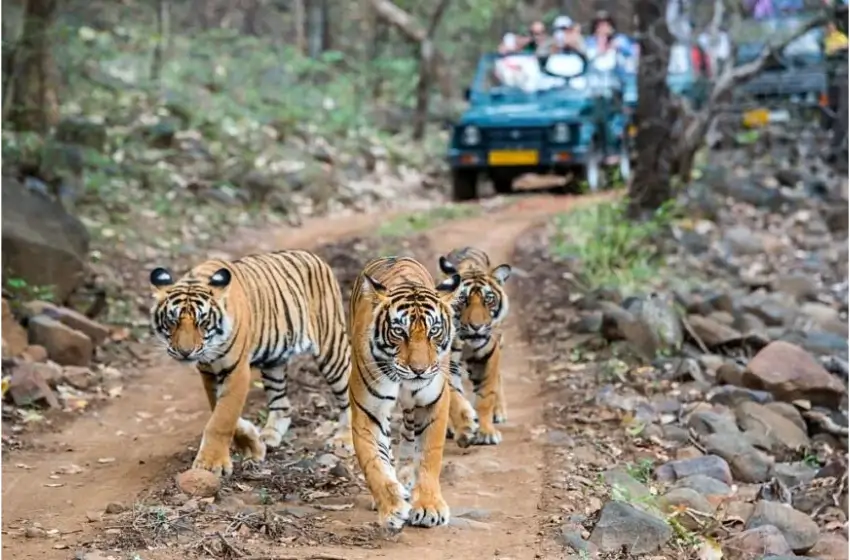
The forest landscape itself is part of the attraction. Ranthambore contains dry deciduous vegetation, rocky terrain, lakes, ruins and the dramatic presence of Ranthambore Fort above parts of the reserve. Visitors may encounter sambar deer, spotted deer, nilgai, langurs, crocodiles, birds and other wildlife even when a tiger is not seen.
A good Ranthambore tiger safari should therefore be approached as a wildlife outing rather than a tiger appointment. This mindset makes the safari far more rewarding and avoids the unrealistic expectation that every vehicle will see a tiger on every drive.
Safari timing changes according to the season because daylight hours vary through the year. During October, morning safaris commonly operate around 6:30 a.m. to 10:00 a.m., with afternoon drives around 2:30 p.m. to 6:00 p.m. During November through January, morning timings commonly move to approximately 7:00 a.m. to 10:30 a.m., while afternoon safaris may run around 2:00 p.m. to 5:30 p.m.
During February and March, the usual schedule commonly returns to approximately 6:30 a.m. to 10:00 a.m. in the morning and 2:30 p.m. to 6:00 p.m. in the afternoon. From early April to mid-May, safaris can operate around 6:00 a.m. to 9:30 a.m. and 3:00 p.m. to 6:30 p.m. Later in May and June, the afternoon period can shift later, commonly to around 3:30 p.m. to 7:00 p.m.
These times should always be checked again close to the travel date because forest authorities can revise operational arrangements. Visitors should also be ready before the actual safari time because vehicle pickup, permit verification and travel to the relevant entrance require additional time.
Foreign travelers should never schedule a train, flight or long road departure immediately after the expected safari end time. Delays can occur, and the journey from the forest back to the hotel also requires time.
The main Ranthambore tourism season generally runs from October through June, although current zone operations and seasonal closures should always be verified for the intended dates. October through March attracts many international visitors because the weather is more comfortable. Morning safaris in December and January can be cold, so travelers should carry warm layers even though Rajasthan is often imagined as a permanently hot destination.
April through June becomes substantially hotter, with temperatures during the day capable of becoming intense. The heat can be physically demanding for visitors, particularly during open-vehicle safaris. However, the dry season can influence animal movement around remaining water sources, which is one reason serious wildlife travelers may still choose these hotter months.
There is no month that guarantees tiger sightings. Wildlife observation depends on many factors, including animal movement, weather, vegetation, zone and chance. Travelers should be cautious of anyone promising a guaranteed tiger simply because a particular month or zone has been selected.
The best time for Ranthambore safari therefore depends on priorities. Visitors focused on comfortable weather often favor November through March, while wildlife enthusiasts willing to tolerate stronger heat may also consider April, May or June. Families with elderly parents should usually give greater weight to temperature and physical comfort.
Safari clothing should be practical rather than formal. Neutral, comfortable clothing works well, and visitors should select layers according to season. Winter mornings can feel very cold in an open vehicle because wind exposure makes the temperature feel lower than it does while standing outside the hotel. A warm jacket, scarf and additional layer can therefore be extremely useful in December and January.
During warmer months, lightweight breathable clothing is more comfortable, but visitors should still consider sun exposure. A hat, sunglasses and appropriate sun protection are useful because safari vehicles are open. Long sleeves can provide additional sun and dust protection without requiring heavy clothing.
Comfortable closed shoes are generally preferable to delicate footwear. Visitors spend most of the safari inside the vehicle, but hotel pickups and stops can involve dusty ground. Clothing in very bright colors is unnecessary, although tourists do not need to purchase special camouflage clothing simply for a standard safari.
Camera equipment should be manageable. Large lenses are useful for serious wildlife photography, but travelers should remember that space in a shared vehicle is limited. A phone or ordinary travel camera can still capture excellent photographs when wildlife appears close enough.
Foreign visitors should also check current rules regarding mobile-phone use within tourism zones because regulations can change and restrictions may apply.
Both morning and afternoon safaris can produce excellent wildlife sightings, and neither should be presented as a guaranteed superior choice. Animal activity changes according to temperature, weather and individual movement. A tiger seen beside a track in the morning may be resting far from visitor routes by afternoon, while another animal may become active later in the day.
Morning safaris have the advantage of cooler temperatures, particularly outside winter. The forest can feel especially atmospheric shortly after sunrise, and photographers may appreciate softer early light. During December and January, however, the open vehicle can feel very cold, making warm clothing essential.
Afternoon safaris provide warmer conditions during winter and can finish with attractive late-day light. During April, May and June, the afternoon heat can be intense before temperatures begin dropping closer to sunset. Visitors sensitive to heat should take this into account.
For a two-night stay, booking one morning and one afternoon Ranthambore safari can provide useful variety. It gives travelers two different periods in the forest and increases the total time available for wildlife observation without assuming that either session guarantees a particular sighting.
It is possible, but it should be approached cautiously. The Agra-Ranthambore road journey requires several hours, and afternoon safaris have fixed seasonal entry times. If the vehicle encounters traffic, road works or another delay, the traveler may reach the hotel or pickup point too late. Safari permits cannot simply be shifted by an hour because the tourist arrived late from another city.
If an afternoon safari is essential, travelers should leave Agra early in the morning and travel directly without adding Fatehpur Sikri, Bharatpur or a long lunch stop. The exact departure should be calculated using the seasonal safari time and hotel location, with a substantial safety margin.
For most foreign visitors, arriving in Ranthambore the previous afternoon and beginning with a morning safari is more comfortable. This removes road-transfer anxiety and allows guests to start the wildlife portion rested.
A private transfer from Agra to Ranthambore should therefore be coordinated with the safari permit rather than booked independently. The hotel, safari and road schedule all need to work together.
Ranthambore fits particularly well between Agra and Jaipur. After completing the wildlife stay, travelers can continue toward Jaipur instead of returning to Agra. The Ranthambore to Jaipur distance is roughly 170 to 190 kilometers depending on the hotel and route, and the road journey generally requires around three and a half to four and a half hours under normal conditions.
This creates an efficient route of Agra to Ranthambore to Jaipur. Visitors see the Taj Mahal and Mughal architecture in Agra, spend two or three nights around the tiger reserve and then continue into Rajasthan's capital for forts and palaces. The journey avoids unnecessary backtracking and adds wildlife variety to the classic Golden Triangle.
Travelers taking a morning safari on the departure day should return to the hotel, have breakfast or an early lunch, check out and then drive to Jaipur. Arrival will normally be later in the day, so major Jaipur sightseeing should begin the following morning rather than immediately after hotel check-in.
This sequence works especially well within a Golden Triangle tour with Ranthambore, creating a route such as Delhi, Agra, Ranthambore and Jaipur before returning to Delhi or continuing farther into Rajasthan.
A practical itinerary begins with departure from the Agra hotel after breakfast. Travelers drive directly toward Ranthambore, allowing approximately five to six hours with a comfortable meal or refreshment break. After reaching the resort, the afternoon and evening remain free for rest. This prevents the road journey from being tied to a fixed safari deadline and allows guests to settle into the wildlife portion of the holiday.
The second day can include a morning safari followed by breakfast or lunch and several hours at the resort. An afternoon safari can then provide a second opportunity to enter the forest. Travelers who prefer a slower schedule can choose only one safari that day and keep another for the following morning.
On the third day, visitors can take another morning safari when booked, return to the hotel, have breakfast and continue toward Jaipur. This creates two or three wildlife drives across a two-night stay while still fitting neatly between Agra and Jaipur.
The itinerary can be extended to three nights for serious photographers or visitors who want more safari opportunities. Wildlife is unpredictable, so additional drives increase time spent in the forest without ever guaranteeing a tiger sighting.
India Agra Tours can arrange the Agra to Ranthambore private car transfer, onward Ranthambore-to-Jaipur transportation and a wider North India itinerary according to the traveler's available days.
The Agra to Ranthambore road distance is approximately 240 to 260 kilometers, depending on the exact hotel locations and route. Travelers should generally allow around five to six hours for a comfortable private-car journey, including normal road conditions and a short break.
A professionally arranged sedan can commonly cost around ₹7,000 to ₹9,000, while a larger SUV or MPV may cost approximately ₹9,000 to ₹12,000 or more. The final price depends on the vehicle, route, sightseeing stops and included road charges.
Yes. Fatehpur Sikri can be included between Agra and Ranthambore when the first safari is not scheduled too early on the arrival day. Visitors should allow approximately 1.5 to two hours for the monument, making the overall transfer substantially longer.
It is possible when the journey begins very early and no major stops are included, but the schedule carries some risk because road delays can cause visitors to miss the fixed safari entry time. Arriving in Ranthambore the previous afternoon is usually more comfortable.
At least two nights in Ranthambore are recommended for most first-time visitors. This provides time for two or more safari opportunities without making the wildlife stay dependent on a single drive.
A Gypsy carries fewer passengers and is often preferred by couples, families and photographers, while a Canter is a larger shared vehicle. Neither vehicle guarantees a tiger sighting, and both operate within the official safari system.
No. Tigers and other animals move freely in a natural reserve, so Ranthambore tiger sightings cannot be guaranteed. Taking more than one safari gives visitors additional time in the forest but still does not create certainty.
Foreign travelers should provide the required passport details when making the safari reservation and carry the original identification used for the permit. Booking details should match the travel document accurately to avoid problems during verification.
Yes. Agra-Ranthambore-Jaipur is an efficient route for foreign tourists. It adds wildlife to the Golden Triangle without requiring travelers to return to Agra after the safari stay.
Yes. India Agra Tours can arrange an Agra to Ranthambore private car with driver, followed by onward transportation to Jaipur or another Rajasthan destination. The route can be combined with a Taj Mahal visit, Golden Triangle itinerary and a two- or three-night Ranthambore stay according to the traveler's schedule.