Taj Mahal Entry Fee for Foreigners (Complete Guide)
13 May 2025
The Taj Mahal may be the monument that brings most international travelers to Agra, but leaving the city immediately after seeing it means missing one of the most important Mughal monuments in India. Agra Fort is not simply another fort added to an Agra sightseeing list. For generations of Mughal rulers, it functioned as a royal residence, military stronghold and center of imperial power, and its surviving palaces, courtyards, audience halls and river-facing structures help visitors understand the history surrounding the Taj Mahal far better.
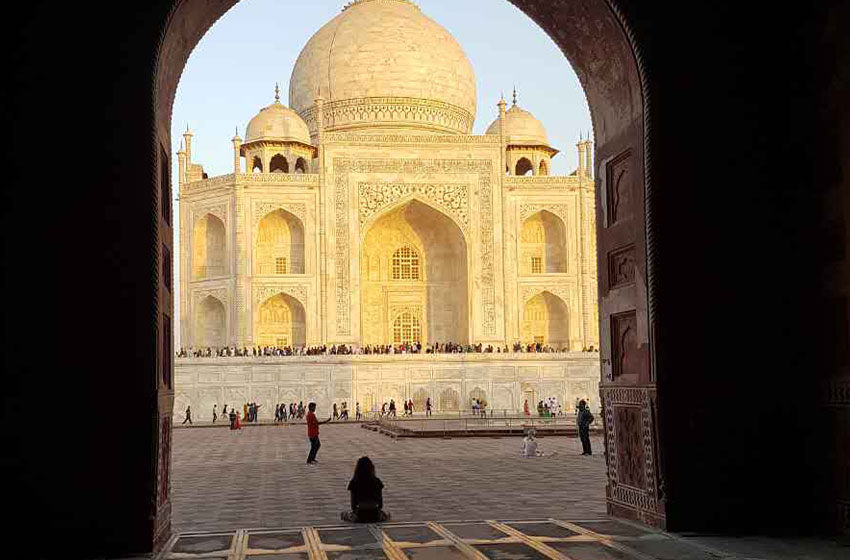
Located close to the Yamuna River, Agra Fort in Agra is easily combined with the Taj Mahal during the same stay. The two monuments are also historically connected. Emperor Shah Jahan, responsible for the Taj Mahal, spent the final part of his life confined within Agra Fort after his son Aurangzeb took control of the Mughal throne. From parts of the fort, visitors can look toward the Taj Mahal across the river, creating one of the most memorable views inside the complex.
The fort is a UNESCO World Heritage Site and covers a substantial area. What visitors see today is only part of the larger historic complex, and sightseeing involves walking through multiple gates, courtyards and palace sections. A rushed thirty-minute stop does not do the monument justice. Most first-time foreign tourists should allow approximately 1.5 to 2 hours for Agra Fort, while travelers with a serious interest in Mughal architecture, photography or history can easily spend longer.
The fort is generally open from sunrise to sunset, and visitors should verify the current official opening hours before arrival because seasonal daylight and operational arrangements can change. Foreign visitors should budget approximately ₹650 per adult for standard admission under the commonly applied ticket structure, while Indian visitors commonly pay around ₹50 per adult. Official ticket rates can be revised, so the applicable price should always be checked when purchasing.
For visitors using India Agra Tours, Agra Fort can be included with the Taj Mahal, Mehtab Bagh and other important Agra attractions in a private sightseeing schedule with a car, driver and local guide.
To appreciate Agra Fort history, it helps to understand that the site existed before the red sandstone Mughal fort visitors see today. Agra had strategic importance before Emperor Akbar transformed the location into a major imperial fortress. Under Akbar, extensive rebuilding in red sandstone turned the fort into one of the most powerful royal complexes of the Mughal Empire. Construction began during the sixteenth century, and thousands of workers were involved in creating the massive defensive walls, gates, palaces and administrative spaces.
Akbar's fort was not simply a military installation. It served as an imperial city within a fortified enclosure. Members of the royal family lived here, important government decisions were made here, and the complex contained residential, ceremonial and defensive structures. Its position near the Yamuna River also had strategic importance at a time when waterways played a significant role in transport and imperial life.
Later Mughal rulers altered the fort according to their own tastes. Emperor Jahangir inherited the complex, while Shah Jahan introduced the white marble architecture more commonly associated with his reign. This is why visitors moving through Agra Fort see a striking mixture of massive red sandstone construction and more delicate marble buildings. The contrast helps demonstrate how Mughal architectural preferences changed between Akbar and Shah Jahan.
The fort also became the setting for one of the most famous episodes in Mughal history. During the struggle for succession among Shah Jahan's sons, Aurangzeb emerged victorious and Shah Jahan was confined at Agra Fort. Popular historical accounts connect his final years with views toward the Taj Mahal, the mausoleum he had commissioned for his wife Mumtaz Mahal.
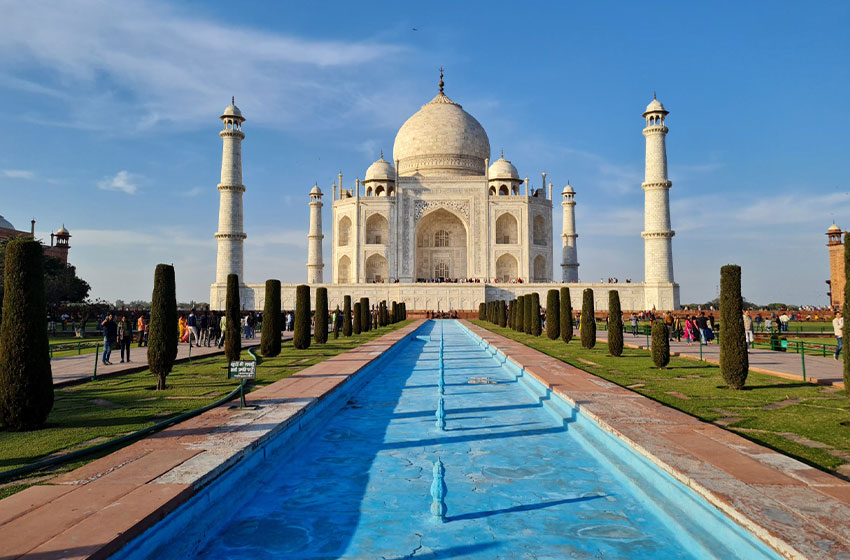
That connection gives Agra Fort and Taj Mahal a relationship that goes far beyond geography. The Taj Mahal represents Shah Jahan's monumental architectural legacy, while Agra Fort represents imperial power, family conflict and the later years of his life.
Foreign visitors who see the Taj Mahal first often find that Agra Fort adds historical depth to the day. The Taj Mahal is visually perfect and highly symmetrical; Agra Fort feels more like an entire royal world, with layers of construction revealing different rulers and purposes.
A knowledgeable local guide can be particularly useful because many courtyards and structures are difficult to understand from appearance alone. Without historical context, visitors may see a succession of beautiful buildings. With context, those buildings become royal residences, audience halls, defensive spaces and places connected with specific Mughal emperors.
Agra Fort opening hours are generally from sunrise until sunset. Unlike the Taj Mahal, which is normally closed to general tourists on Fridays, Agra Fort is generally available throughout the week under its normal operating schedule. Visitors should nevertheless confirm the current official timing before arriving because monument regulations and operational arrangements can change.
The best time depends heavily on the season.
From roughly October through March, the cooler weather makes longer walking visits more comfortable. Morning visits are particularly pleasant, although December and January can bring cold temperatures and occasional fog. If visibility is poor early in the morning, the distant Taj Mahal view from the fort may be less clear.
During spring and early summer, an early visit becomes increasingly valuable. Large sections of Agra Fort involve open courtyards and outdoor walking. By late morning and afternoon, strong sunshine can make sightseeing tiring.
During the hottest period, visitors should avoid treating the fort as a quick outdoor stop in the middle of the day. Comfortable footwear, drinking water according to current monument rules and sun protection become important.
July through September bring the possibility of monsoon rain. The fort can look particularly dramatic under dark clouds because its red sandstone becomes visually richer when wet, but stone surfaces may also become slippery. Visitors should wear shoes with adequate grip and carry lightweight rain protection.
For travelers seeing the Taj Mahal and Agra Fort in one day, the Taj Mahal is often visited first in the morning, followed by breakfast and Agra Fort later. This works particularly well for people interested in sunrise at the Taj Mahal.
Another option is to visit Agra Fort first and keep the Taj Mahal for later afternoon, depending on the season and the visitor's preferred photography conditions.
There is no requirement to rush directly from one monument to the other. A short break for breakfast or lunch can make the day significantly more comfortable, especially for families and elderly travelers.
Understanding the Agra Fort ticket price before arriving prevents confusion at the entrance.
Under the commonly applied ticket structure, foreign visitors should budget approximately ₹650 per adult, while Indian visitors generally pay around ₹50 per adult. Rates for visitors from certain neighboring countries or specific categories may differ according to official rules. Children below the officially defined age threshold may qualify for free entry.
Because Archaeological Survey of India ticket rates and ticketing arrangements can change, travelers should verify the current official price immediately before purchasing. Old blogs, screenshots and travel forums can continue circulating long after a ticket revision.
Visitors should use authorized ticketing channels rather than purchasing entry from unofficial individuals around tourist areas.
Online tickets can be particularly convenient during busy periods. They reduce the need to spend unnecessary time at a physical ticket counter and can make entry easier for families, groups and travelers with limited time.
The Agra Fort entry ticket covers access to the visitor areas currently open to the public. Not every part of the historic fort is open for tourism, so visitors should not expect unrestricted access to the entire original complex.
Security screening takes place before entry. Travelers should carry only necessary belongings and avoid bringing prohibited items. A smaller bag makes the process faster and leaves the visitor more comfortable during the long walk through the fort.
A ticket provides access to the monument, but a professional guide is separate. Foreign travelers interested in Mughal history may find a licensed local guide valuable because there is a great deal more to understand than can be learned simply by looking at the buildings.
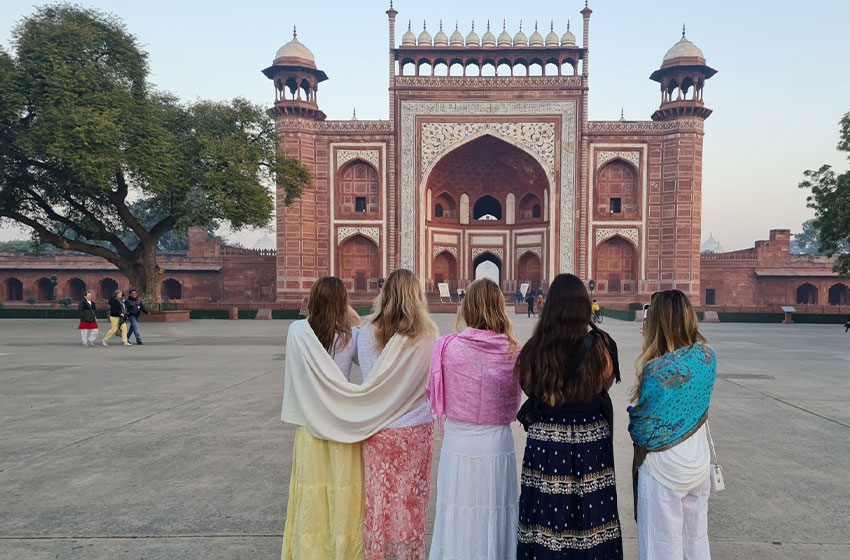
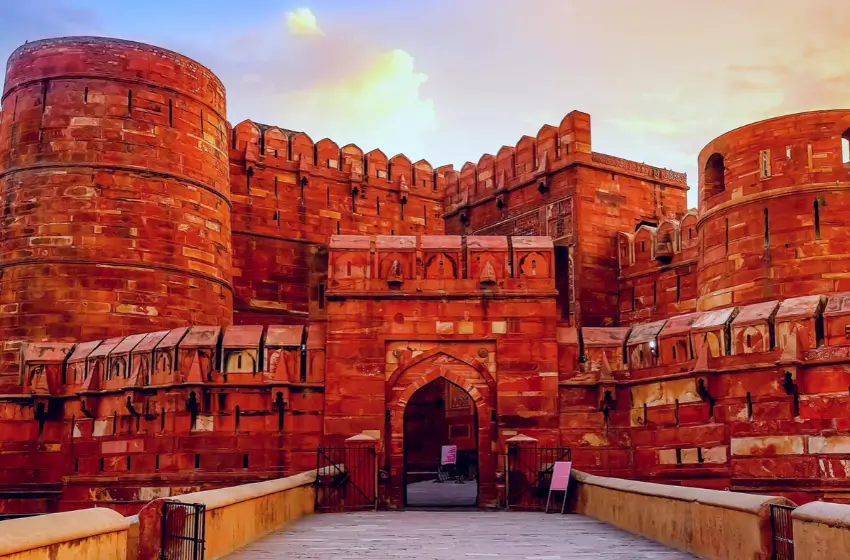
For modern tourists, Amar Singh Gate is the principal visitor entrance to Agra Fort and provides an immediate sense of the defensive character of the complex.
The entrance is deliberately imposing. Mughal forts were not designed with the simple straight-line entrances found in modern buildings. Defensive architecture used strong walls, controlled approaches and carefully positioned gateways to make an attacking force's progress more difficult.
As visitors pass through the entrance, the enormous scale of the fort becomes clearer. The outer red sandstone walls extend around a vast complex, and the architecture immediately feels different from the delicate white marble of the Taj Mahal.
This contrast is important.
The Taj Mahal was designed primarily as a monumental mausoleum and garden complex. Agra Fort had to function as a fortified center of imperial government and royal residence. Strength and protection therefore play a much more obvious role in its architecture.
Visitors should not rush through the entrance simply to reach the famous palaces inside. Looking at the thickness of the walls, the shape of the approach and the construction of the gateway helps explain why Agra Fort was such an important military and political stronghold.
The walking begins almost immediately, which is worth remembering for elderly visitors. Families traveling with parents who have limited mobility should allow a slower pace and discuss current accessibility arrangements before entering.
From the entrance, visitors gradually move toward the principal surviving palace areas. The experience changes from defensive architecture to increasingly elaborate royal spaces, which is one of the most interesting aspects of an Agra Fort sightseeing tour.
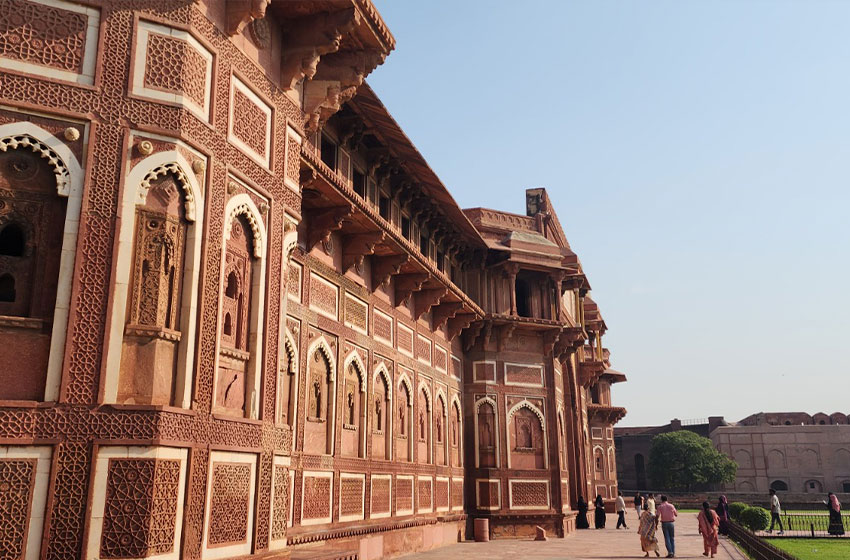
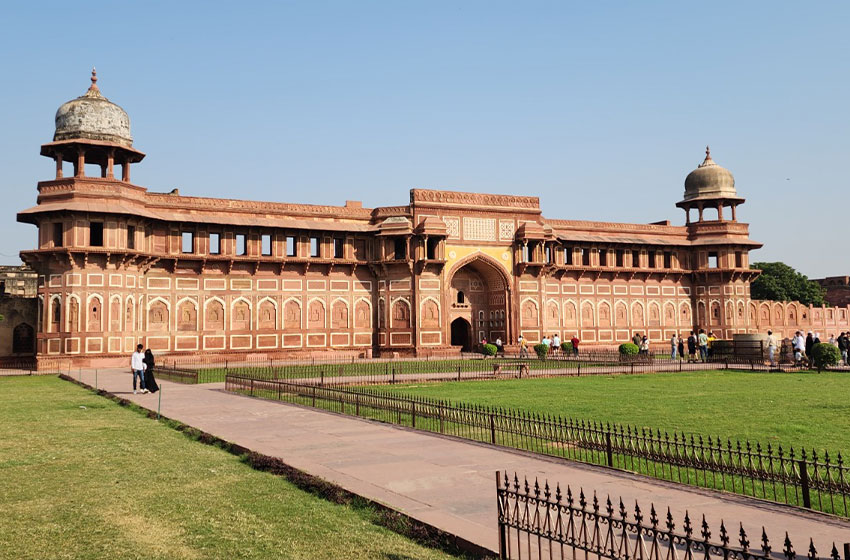
Jahangiri Mahal is one of the most substantial palace structures visitors encounter inside Agra Fort and is an essential stop for anyone interested in Mughal architecture.
Although its name is associated with Jahangir, the palace is closely connected with Akbar's period and demonstrates the rich red sandstone style associated with his reign. Visitors can see carved surfaces, brackets, balconies, geometric forms and architectural details that reveal influences extending beyond a single artistic tradition.
The palace is particularly useful for understanding the difference between Akbar's architecture and the later marble structures associated with Shah Jahan.
Instead of the almost ethereal white appearance of the Taj Mahal, Jahangiri Mahal feels solid and richly textured. The sandstone catches light differently throughout the day, making the building particularly rewarding for photography.
Visitors should spend time in the courtyard rather than simply walking through it.
Looking upward at balconies, carved supports and openings reveals details that are easily missed when following a group quickly from one room to another.
The palace also gives visitors a better idea of how Agra Fort functioned as a residence rather than merely a military structure. This was a place connected with royal life, and the architecture combines privacy, comfort and ceremonial importance within the security of the fort.
For photographers, the repeating architectural details and shadows can be as interesting as the wider courtyard.
Jahangiri Mahal is therefore one of the sections where having enough time at Agra Fort becomes valuable. Visitors attempting to complete the entire fort in less than an hour often move through these spaces without appreciating the workmanship.
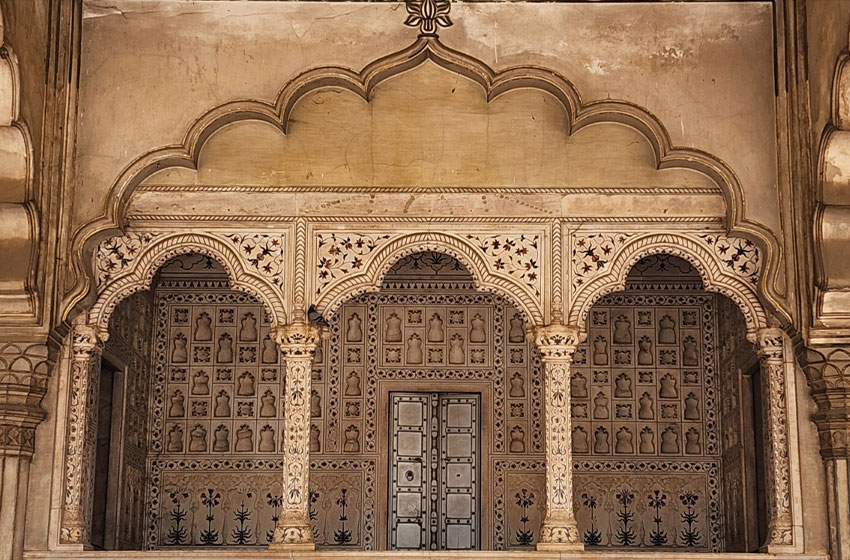
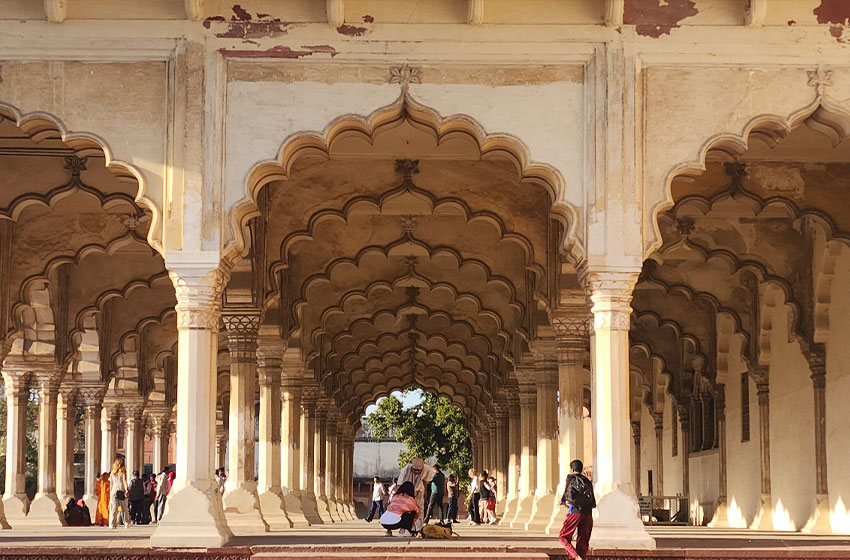
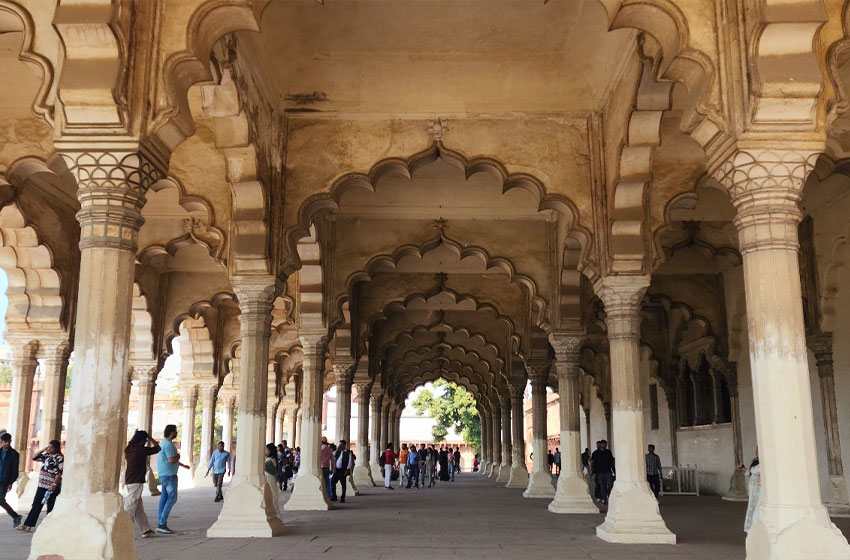
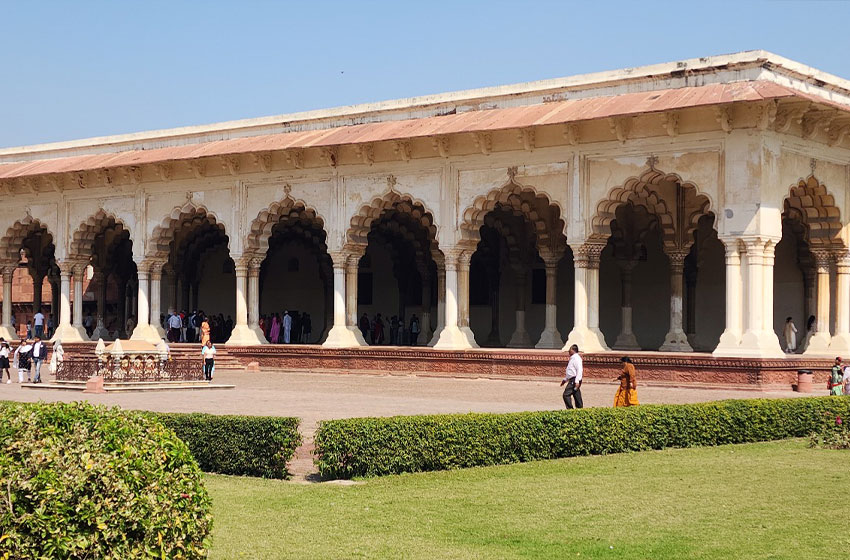
The Diwan-i-Am at Agra Fort was associated with the emperor's public audiences and official interactions. Its purpose helps visitors understand that the fort was not simply a royal home; it was also a functioning center of government.
Mughal emperors ruled a vast empire, and ceremonial architecture reinforced the relationship between ruler, court and subjects. Audience halls provided carefully designed spaces where imperial authority could be displayed.
The Diwan-i-Am is more open than the private palace sections. Its rows of columns and broad layout reflect its public function.
For foreign visitors unfamiliar with Mughal court traditions, this part of the fort becomes much more meaningful when the guide explains how imperial audiences operated and how architecture was used to separate different levels of access to the ruler.
The contrast between public and private space continues throughout the fort.
After seeing a large ceremonial area such as the Diwan-i-Am, visitors move toward more intimate marble structures associated with royal family life. That transition helps make Agra Fort feel like a functioning palace complex rather than a collection of unrelated buildings.
Photography is straightforward in many open sections, but visitors should remain respectful of barriers and restricted areas. Historic surfaces should not be climbed or touched unnecessarily simply to create photographs.
The Khas Mahal demonstrates the architectural change that took place under Shah Jahan.
Where Akbar favored extensive red sandstone construction, Shah Jahan became strongly associated with white marble and more delicate decorative work. The Taj Mahal is the greatest expression of that preference, but Agra Fort also contains important examples.
Khas Mahal served as a private palace and occupies a beautiful position within the fort. Its lighter appearance creates a striking contrast with the heavy red sandstone defensive walls encountered earlier in the visit.
This contrast is one of the main reasons Agra Fort should be visited slowly.
Within a relatively short walk, travelers move through architecture representing different emperors, different artistic preferences and different functions. Massive military walls lead to ceremonial spaces and then to elegant private palaces.
The river-facing setting also becomes increasingly important around these palace areas.
Before modern development changed the surrounding landscape, the Yamuna was deeply connected with Agra's Mughal architecture. Palaces and gardens were positioned in relation to the river, and the Taj Mahal itself stands on its bank.
Visitors should therefore look beyond the individual rooms and notice how buildings are positioned toward the river.
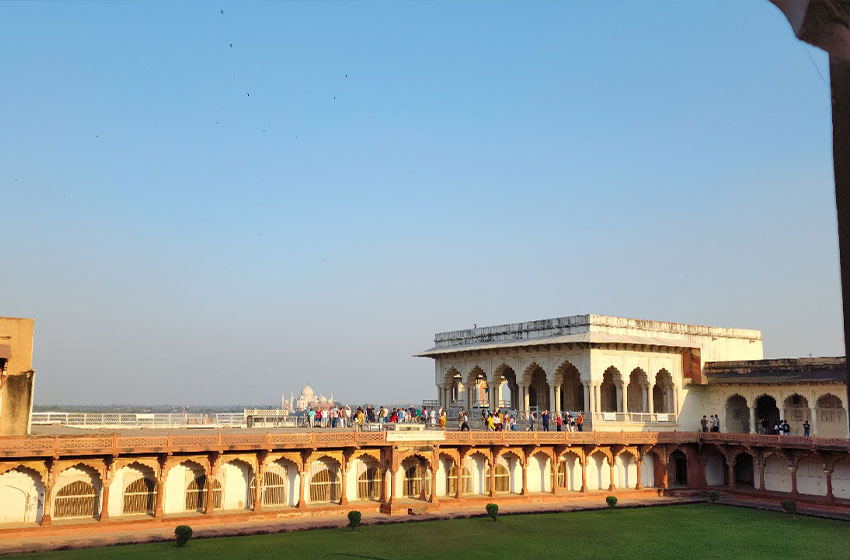
For many foreign visitors, Musamman Burj becomes one of the most memorable parts of Agra Fort because of its association with Shah Jahan and its view toward the Taj Mahal.
The elegant marble pavilion is connected with the story of Shah Jahan's confinement after Aurangzeb seized power. According to the widely told historical narrative, Shah Jahan spent his final years within the fort with a view toward the Taj Mahal, where Mumtaz Mahal was buried.
Whether a visitor arrives primarily interested in architecture or history, the emotional connection between these two monuments is difficult to ignore.
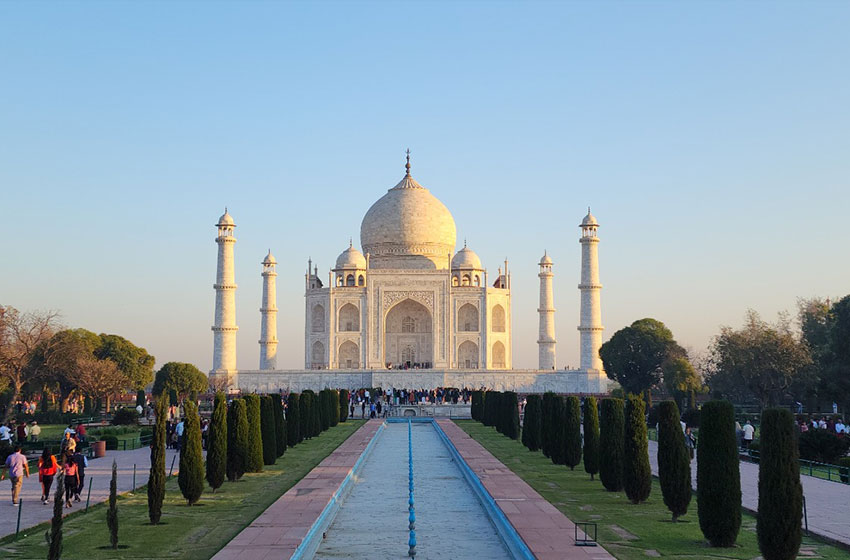
The Taj Mahal appears in the distance across the Yamuna rather than dominating the landscape as it does from its own gardens. The view places the mausoleum within the broader geography of Mughal Agra.
Visibility depends heavily on weather.
A clear day can provide a sharp view, while winter haze or fog may partially obscure the monument. Monsoon clouds can create a dramatic atmosphere, and late-afternoon light can soften the distant marble.
Visitors interested in photography should consider carrying a lens with some zoom capability. A smartphone can capture the scene, but the Taj Mahal will appear relatively distant unless optical zoom is available.
Musamman Burj should not be rushed. It is one of the places where the history of Shah Jahan, Agra Fort and the Taj Mahal comes together most clearly.
Another name visitors encounter inside Agra Fort is Sheesh Mahal, commonly translated as the Mirror Palace. Mughal decorative architecture frequently used reflective surfaces, intricate ornamentation and carefully controlled light to create luxurious interiors.
Access to individual historic sections can change because conservation work and monument management sometimes require areas to be restricted. Travelers should therefore accept that a structure mentioned in an old guidebook may not always be fully accessible during every visit.
The fort also contains other important spaces and architectural remains associated with royal residence, administration and ceremonial life.
Rather than trying to memorize every building name before arrival, first-time visitors may find it more useful to understand the larger story: Akbar's powerful sandstone fortress gradually became an increasingly refined palace complex under later emperors, particularly Shah Jahan.
That architectural evolution is visible throughout the walk.
A private guide can concentrate on the sections currently open and most relevant to the visitor's interests. Someone interested primarily in architecture may spend longer studying decorative details, while a family with children may prefer a shorter historical narrative and more time at viewpoints.
Most foreign visitors should allow approximately 1.5 to 2 hours at Agra Fort.
That is enough time for a comfortable walk through the principal visitor areas, historical explanation, photographs and a pause at the Taj Mahal viewpoint.
A traveler with a strong interest in Mughal architecture can easily spend two to three hours.
Trying to complete the fort in 30 or 45 minutes usually means walking rapidly past major structures without understanding them. Considering the ticket cost and historical importance of the monument, this is rarely worthwhile.
Families with elderly parents should allow additional time because the fort requires considerable walking. Rest breaks may be necessary, particularly during hot weather.
The amount of time also depends on whether a guide is being used.
A guided visit naturally takes longer because the traveler receives historical context rather than simply walking through the buildings. For first-time foreign tourists, this additional time is generally worthwhile.
Visitors combining the Taj Mahal and Agra Fort in one day should allow approximately two to three hours for the Taj Mahal and another 1.5 to two hours for Agra Fort, plus transport, security checks and meal breaks.
This is why a proper Agra day should not be compressed unnecessarily.
The two monuments work extremely well together because they tell different parts of the Mughal story.
A popular schedule begins with the Taj Mahal in the morning. After spending sufficient time inside the complex, visitors can have breakfast or take a short break before continuing to Agra Fort.
At the fort, the historical context becomes richer because the traveler has already seen Shah Jahan's Taj Mahal.
Another comfortable option is to visit the Taj Mahal in the morning, Agra Fort after lunch and Mehtab Bagh around sunset. This produces a complete Agra sightseeing day with three very different perspectives.
Foreign tourists arriving from Delhi on a same-day trip can also see both major monuments. However, road travel needs to be considered when setting the pace.
Travelers who want sunrise at the Taj Mahal should consider staying overnight in Agra. This eliminates the need for an extremely early departure from Delhi and allows the sightseeing day to begin in a more relaxed way.
India Agra Tours can arrange a private Taj Mahal and Agra Fort tour with hotel or Delhi pickup, private air-conditioned transportation and a local guide. The schedule can also include Mehtab Bagh or another suitable Agra attraction when time permits.
Comfortable walking shoes are essential because visiting Agra Fort involves extensive walking on historic surfaces. Footwear with good grip becomes particularly important during the monsoon when stone can become wet.
Carry only necessary belongings. Security checks are easier when visitors do not arrive with large bags or unnecessary equipment.
During warm months, morning sightseeing is preferable. Sun protection and adequate hydration are important because several areas are exposed.
During December and January, layered clothing is useful because mornings can be cold while afternoons become considerably warmer.
Photography is one of the pleasures of Agra Fort, but visitors should follow current rules concerning restricted areas, tripods and professional equipment.
Travelers with limited mobility should investigate current accessibility before arrival. Parts of the fort contain ramps or relatively manageable surfaces, while other historic sections may involve changes in level.
Most importantly, do not treat Agra Fort as an optional five-minute addition after the Taj Mahal.
For travelers interested in Indian history, Agra Fort is one of the most important places to visit in Agra. Its combination of defensive architecture, royal palaces, audience halls, marble pavilions and Taj Mahal views gives visitors a much fuller picture of Mughal Agra.
Agra Fort is generally open from sunrise to sunset. Exact operational hours can change according to monument regulations and seasonal conditions, so visitors should verify the current timing shortly before arrival.
Foreign tourists should budget approximately ₹650 per adult for Agra Fort entry under the commonly applied ticket structure. Official prices can change, so the current rate should be checked before purchasing.
The commonly applied entry charge for Indian adult visitors is approximately ₹50, subject to current official ticket rules and any future revision.
Most travelers should allow around 1.5 to 2 hours. Visitors particularly interested in Mughal history, architecture or photography may prefer two to three hours.
Yes. Certain river-facing areas of Agra Fort offer views of the Taj Mahal across the Yamuna. Visibility depends on weather, haze and fog.
Yes. Agra Fort provides important historical context for the Mughal period and includes palaces, audience halls, courtyards and the famous connection with Shah Jahan. It is one of Agra's most important monuments in its own right.
Agra Fort generally remains open on Fridays under its normal schedule. The Taj Mahal, by contrast, is normally closed to general tourists on Fridays.
Important areas include Amar Singh Gate, Jahangiri Mahal, Diwan-i-Am, Khas Mahal, Musamman Burj and other surviving Mughal structures available within the current visitor route.
Yes. The Taj Mahal and Agra Fort can comfortably be visited on the same day when enough time is allowed. Many visitors see the Taj Mahal in the morning and spend approximately 1.5 to two hours at Agra Fort later.
Yes. India Agra Tours can arrange a private Agra sightseeing tour with Taj Mahal and Agra Fort, including a private air-conditioned car, chauffeur and local guide. Mehtab Bagh and other suitable Agra attractions can also be included according to the available time and preferred sightseeing pace.