Any query? Write us mail.
info@indiaagratours.com
Guide Services Coordinator
+91-9058900786
Chat to Experts
WhatsApp: +91-9058900786
Every Italian who lands in Agra carries the same invisible luggage.
Decades of visual culture. A childhood spent in cities where the word "old" means something entirely different than it does elsewhere. An instinct for proportion, for material, for the difference between a building that was designed and a building that was merely constructed. You don't need to have studied architecture formally to carry this with you — it comes with the territory of growing up Italian.
And then you stand in front of the Taj Mahal for the first time, and something unexpected happens.
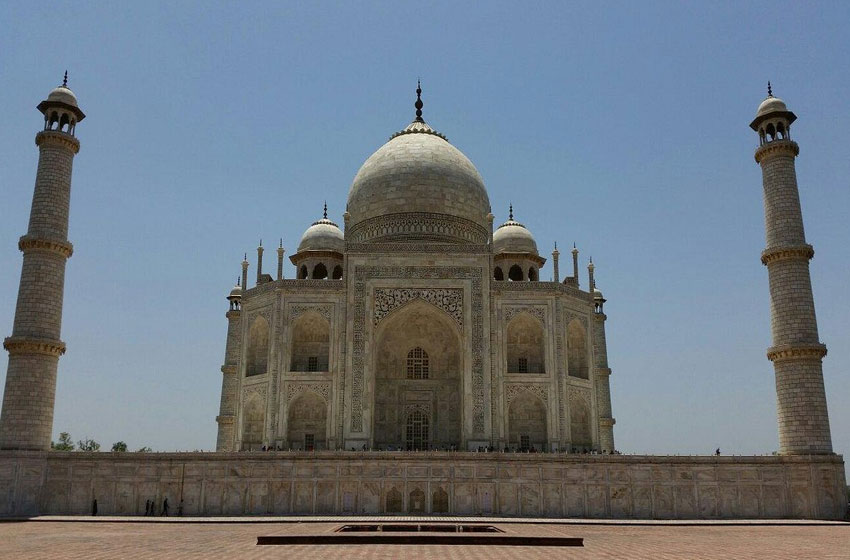
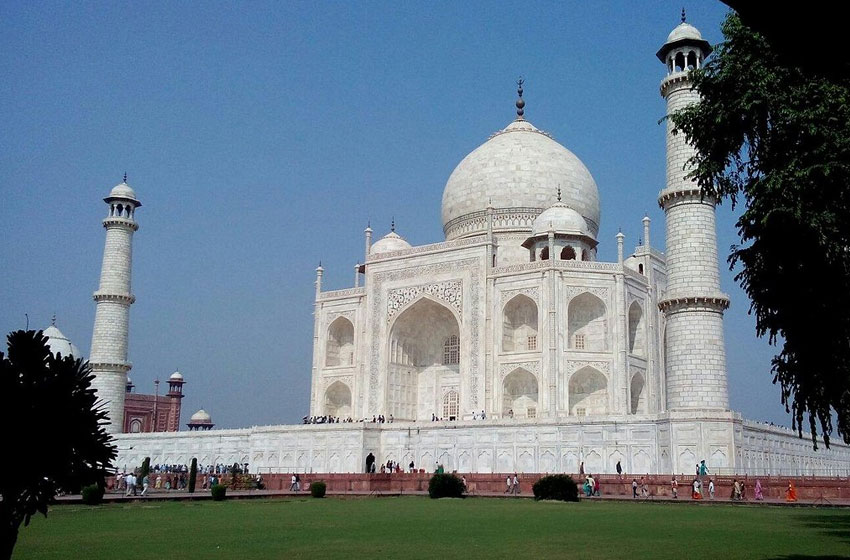
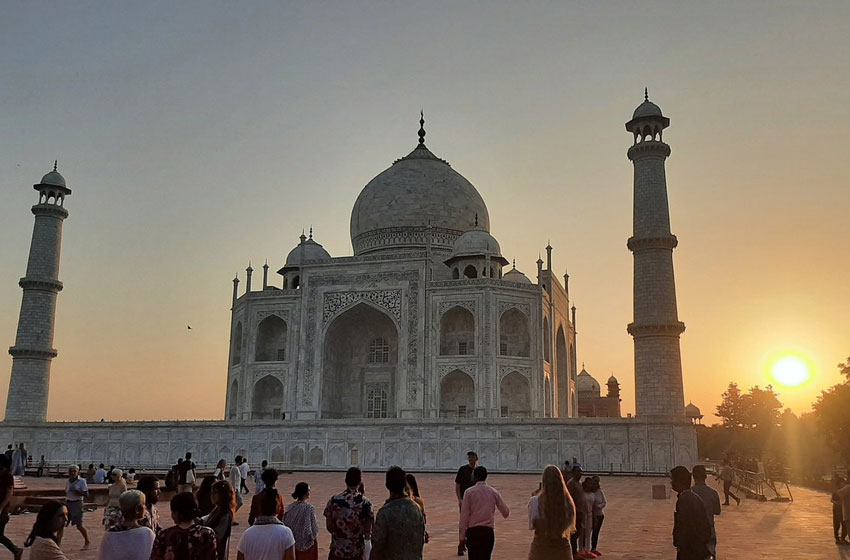
It is better than the photographs. Not slightly better — categorically, embarrassingly better. The photographs have been lying to you for years, not through dishonesty but through the simple impossibility of capturing what happens when seventeen thousand tonnes of white Makrana marble catch the morning light at a particular angle. The monument does not look like its images. It looks like the idea its images were trying to approximate.
That moment — the first thirty seconds in front of the Taj Mahal — needs no guide and no explanation. It needs silence.
What comes after that moment is where a good Italian speaking guide in Agra becomes the difference between a beautiful day and an unforgettable one.
Agra is not a comfortable city. It is dusty, loud, chaotic at the edges, and the journey from Delhi — whether you take the Gatimaan Express or drive the Yamuna Expressway — deposits you into a place that has been absorbing the weight of tourism for decades without becoming particularly graceful about it.
The area around the Taj Mahal's entry gates is a masterclass in organised chaos. Cycle rickshaws, electric vehicles, tour groups from four continents, vendors with the persistence of people who have been doing this for thirty years, and at least three men who will tell you the monument is closed today and offer to take you somewhere better.
None of this matters once you are inside. But getting from the city to the monument with your composure and your schedule intact is genuinely easier with someone who has done it several hundred times before.
A licensed Italian speaking tour guide in Agra is not simply a person who explains things in your language. They are your local intelligence — the person who knows which gate to enter from to avoid the longest queues, what time to arrive for the best light, how to navigate the security process efficiently, and how to spend your hours inside the complex in a way that feels unhurried rather than rushed. That operational knowledge alone is worth the arrangement. Everything else — the history, the architecture, the stories — is what makes the visit genuinely rich.
Ask an Italian what surprised them most about the Taj Mahal and the answer is rarely the size or the grandeur. It is almost always the detail.
Specifically, the pietra dura — or as Mughal craftsmen called it, Parchin Kari. The technique of cutting semiprecious stones into precisely shaped pieces and fitting them into marble surfaces to create images of flowers, vines, and geometric patterns. The same tradition existed in Renaissance Florence. Whether it travelled to Agra along trade routes, or whether two civilisations independently arrived at similar solutions to the same aesthetic problem, is a question historians still argue about over dinner.
What is not argued is the quality of the work at the Taj Mahal. At the plinth level of the main mausoleum, the inlay panels are detailed enough that individual flower petals are represented by stones smaller than a thumbnail, fitted without visible gaps, with gradations of colour that give the botanically accurate flowers a sense of three-dimensional depth. The craftsmen who did this worked without magnification, without power tools, and without the ability to redo a mistake once the stone was set.
An Italian standing in front of this work — someone who grew up understanding that craft is a form of intelligence — tends to go quiet. Your Italian speaking guide gives that silence the time it deserves, and then fills it with the history of how this technique arrived in Agra, who the master craftsmen were, and what became of the tradition after the Mughal period ended.
Italian visitors also tend to notice something about the Taj Mahal that more casual tourists miss entirely: it is designed to be experienced as a sequence, not a sight.
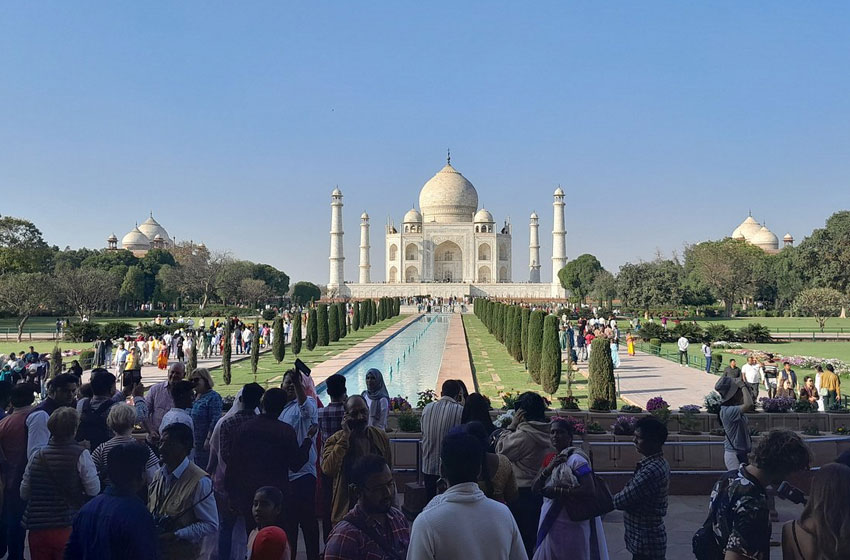
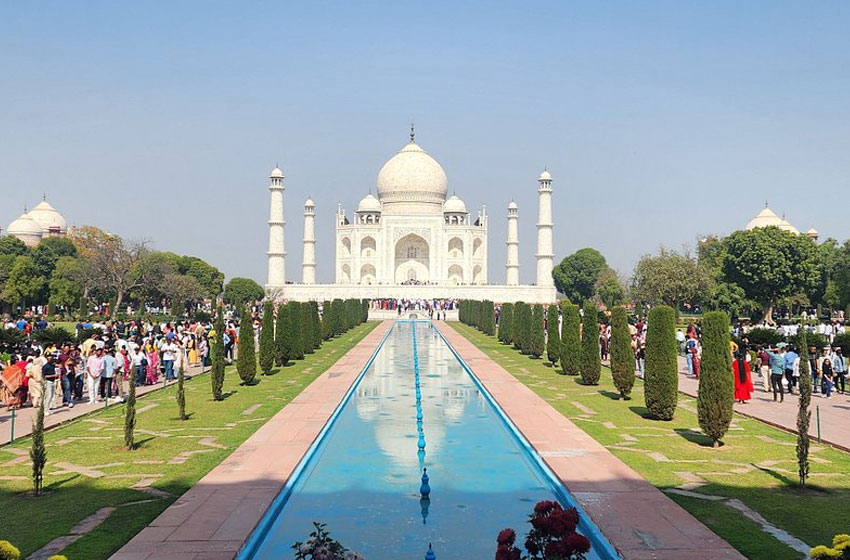
You do not simply arrive and see it. You approach it through a walled forecourt, then pass through the main gateway — the Darwaza-i-Rauza — which frames the monument at the end of a long reflecting pool. The gateway is itself a substantial building, tall enough to completely conceal the Taj Mahal until the moment you step through the central arch. And then it appears.
This is not accidental. The entire entry sequence was designed to control the emotional experience of arrival — to build anticipation, to conceal, and then to reveal. The reflecting pool doubles the monument, creating a visual that occupies both the ground and the sky. The cypress trees lining the garden paths draw the eye forward and upward simultaneously.
For a visitor from a country where this kind of spatial choreography was refined during the Baroque period, the Taj Mahal's approach sequence feels immediately legible as architecture — not just as scenery. A good guide notices what you are responding to and builds the explanation around it.
Here is what the average Agra day trip itinerary gets wrong: it treats Agra Fort as an optional extra, something to fit in if time allows after the Taj Mahal. In reality, you cannot fully understand the Taj Mahal without visiting Agra Fort. The two monuments are chapters of the same story, and the Fort contains the ending.
Shah Jahan, the Emperor who built the Taj Mahal as a tomb for his wife Mumtaz Mahal, spent the last eight years of his life imprisoned inside Agra Fort by his own son. Aurangzeb, the third of Shah Jahan's four sons, seized power in 1658 after a brutal war of succession and placed his father under comfortable but absolute house arrest in the Musamman Burj — an octagonal tower within the Fort that projects out over the Yamuna River.
From the windows of that tower, Shah Jahan could see the Taj Mahal.
Whether this was a kindness or a cruelty is something people have been debating for nearly four centuries. What is certain is that Shah Jahan died in that tower in January 1666, reportedly still looking toward the monument he had built. He was buried in the Taj Mahal beside Mumtaz Mahal — the only disruption to the monument's otherwise perfect symmetry, because his cenotaph, added later and unplanned, sits slightly off-centre next to hers.
Your Italian speaking guide tells this story at the tower. With the Taj Mahal visible across the water. It is the kind of history that does not need embellishment.
If the Taj Mahal is Agra's famous monument and Agra Fort is its complicated one, then Fatehpur Sikri — forty kilometres away across the Rajasthani plain — is its forgotten one. Which is unfair, because Fatehpur Sikri is extraordinary.
Emperor Akbar built an entire imperial capital here between 1571 and 1585. Not a palace, not a fort — a complete city, with administrative buildings, residential quarters, a Friday mosque the size of a city block, and a victory gateway that remains one of the largest arches in the world. He built it, moved his court there, and then within a generation the city was largely abandoned. The most likely explanation is a failure of the local water supply. The most poetic explanation is that Akbar simply moved on, as he moved on from many things — wives, religions, cities, certainties.
What survives is one of the best-preserved ghost towns on earth. Walking through Fatehpur Sikri feels nothing like visiting the Taj Mahal or Agra Fort. It feels like stumbling into somewhere that time genuinely forgot — except the architecture is too deliberate, too considered, too clearly the product of an extraordinary mind, to have been forgotten by anyone who built it.
Akbar's architectural language at Fatehpur Sikri deliberately combined Hindu, Jain, Persian, and Islamic elements — a formal expression of his belief that no single tradition had a monopoly on wisdom or beauty. The result is a building vocabulary that belongs entirely to itself. Italian visitors with an eye for architectural history find it endlessly interesting precisely because it resists easy categorisation.
A full visit to Fatehpur Sikri requires around two hours and works best as a morning excursion from Agra. It sits naturally at the end of a two-day itinerary that begins with an Agra Fort visit on the first afternoon, a Taj Mahal sunrise on the second morning, and Fatehpur Sikri before the drive back to Delhi or onward to Jaipur.
Not every Italian visitor to Agra wants the same experience. A couple on a honeymoon wants something different from a family with teenagers, which is different again from a retired professor of art history on a solo trip, which is different from a group of architects on a study tour.
Our guides adapt to all of these. The historical knowledge base is the same — rigorous, accurate, genuinely deep — but the way it is deployed changes entirely depending on who is listening. A twelve-year-old gets different explanations than a sixty-year-old academic, and neither version is a dumbed-down alternative. Both are simply the right version for that person.
What does not change is the pace, the professionalism, and the absence of commercial pressure. There are no shopping stops built into our tours. No detours to gem workshops or marble showrooms. No second agenda running alongside the historical one. The guide's only job is to make your time at these monuments as rich and as well-informed as possible.
Bookings are simple. WhatsApp is the fastest channel — +91-9058900786 — and most Italian travellers use it because it is convenient and responses come quickly. Email works equally well at info@indiaagratours.com if you prefer to write out your requirements in detail: travel dates, group composition, which monuments you want to cover, and any particular interests you want the guide to focus on.
Pricing is confirmed in writing before any commitment is made. There is no deposit required to hold a booking and no cancellation fee for changes made with reasonable notice.
Agra rewards curiosity. Come with questions — the good ones, the specific ones, the ones that have been sitting at the back of your mind since you booked the flight. A licensed Italian speaking guide in Agra is the right person to answer them.
Any query? Write us mail.
info@indiaagratours.com
Guide Services Coordinator
+91-9058900786
Chat to Experts
WhatsApp: +91-9058900786
An Italian speaking tour guide in Agra is a licensed local guide who provides monument explanations and sightseeing support in fluent Italian.
Yes, we arrange only licensed Italian speaking tour guides in Agra approved by the Tourism Department.
Yes, Italian speaking Taj Mahal tour guide services are available separately.
Yes, a private Italian speaking tour guide in Agra offers personalized attention and flexible timing.
Yes, our Italian speaking tour guide in Agra covers all major monuments.
Yes, guides adjust pace and routes according to traveler comfort.
Yes, same day Agra Italian speaking tour guide services are available.
No, Italian speaking tour guide charges in Agra are discussed clearly in advance.
Yes, first-time visitors benefit greatly from an Italian speaking guide in Agra.
Yes, guides assist with entry timing and procedures.
Yes, families frequently book Italian speaking tour guide services in Agra.
You can call or WhatsApp +91 90589 00786 to arrange the service.