Durations : - 12 Nights / 13 Days
Place Covered : - Delhi - Agra - Ranthambore - Jaipur - Jawai - Udaipur
This thirteen day trip puts two of India's big cats at the centre of a classic route. You start with Delhi and the Taj Mahal, then spend three nights at Ranthambore, a tiger reserve in eastern Rajasthan where tigers hunt among the ruins of old pavilions and lakes below a 10th century fort. Four jeep safaris with an experienced naturalist give you a fair chance of a sighting, along with sloth bears, crocodiles, deer and a long list of birds.
The second half heads to Jawai in southern Rajasthan, a landscape of granite hills, scrub and farmland where leopards live in rock caves right next to villages. The Rabari herders who graze their flocks here have shared the hills with leopards for generations, and the cats are seen most days from open jeeps guided by local trackers. Between the two wildlife stops you have two nights in Jaipur, and the trip ends with two nights on the lakes of Udaipur before your flight home.
Lodges and hotels are among the best in India: Sher Bagh, the Oberoi Vanyavilas or Aman-i-Khas at Ranthambore, and SUJÁN Jawai, a small luxury tented camp among the rocks. A private chauffeur and car stay with you from Delhi to Udaipur. The best months are October to March. Ranthambore's core zones close from 1 July to 30 September, and the trip is not offered then. Every departure is private, so dates and hotels can be adjusted.
Our representative meets you outside the customs hall at Indira Gandhi International Airport with a name board and walks you to your car. The drive to your hotel in central Delhi usually takes between 40 minutes and an hour. Many flights from Europe, the US and Australia land late at night, so nothing at all is planned today. Your room is ready on arrival when you book early check-in, which we recommend if your flight lands in the early morning.
Use the rest of the day to sleep and adjust to the time difference. India is four and a half to five and a half hours ahead of London and nine and a half or more ahead of New York, so the first night can feel short. If you are awake in the evening, your tour manager will call to go through the trip, explain how the safari permits work and collect copies of your passports, which the forest department needs for every Ranthambore booking.
Overnight: Delhi
Leave the hotel after an early breakfast and spend an hour at Humayun's Tomb before the tour groups arrive. Built in the 1560s by the widow of the second Mughal emperor, it was the first garden tomb on this scale in India. Your guide shows you how the red sandstone and white marble design, the raised platform and the four part garden were later refined in the Taj Mahal. The surrounding garden was restored in the early 2000s, and its water channels run again.
Then drive to Agra on the Yamuna Expressway, about three and a half hours. After check-in and lunch, visit Agra Fort, whose walls of red sandstone run for about 2.5 km along the river. Inside are Akbar's early buildings and the white marble rooms that Shah Jahan added later. Before sunset cross the river to Mehtab Bagh, a Mughal garden directly opposite the Taj. Rangers here sometimes point out peacocks and parakeets in the trees, a small preview of the wildlife days ahead.
Overnight: Agra
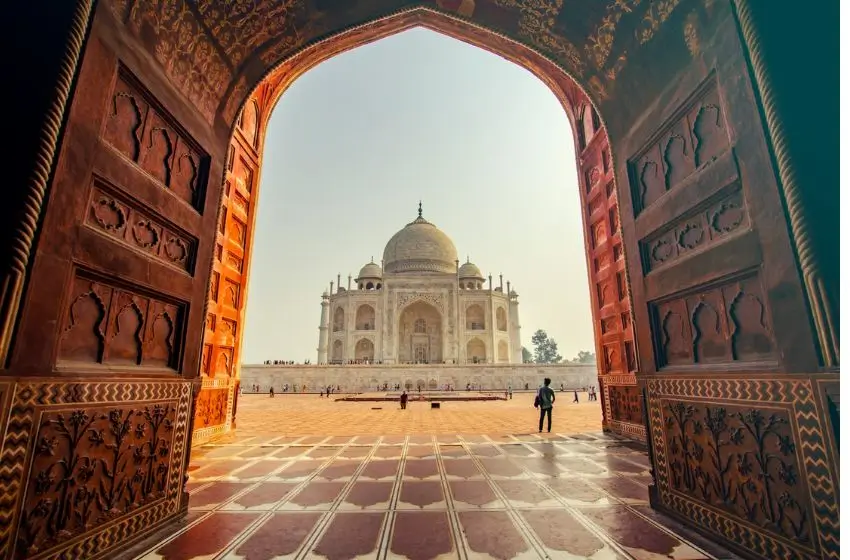
Walk into the Taj Mahal grounds as the gates open around sunrise. Early in the morning the marble looks almost grey, then warms to cream as the sun rises over the river. Your guide explains how Shah Jahan built the tomb in memory of his wife Mumtaz Mahal, who died in 1631, and how about twenty years of work by thousands of craftsmen went into it. Remember that the Taj is closed every Friday, and your dates are planned around that.
After breakfast, drive west to Ranthambore, about five and a half to six hours with stops. You can break the journey at Fatehpur Sikri, Akbar's abandoned capital about 40 km from Agra, for a short visit. If you prefer the train, a service from Agra to Sawai Madhopur can replace most of the drive. You reach the lodge in the late afternoon. Over dinner, your naturalist explains the park zones, how tigers mark their territory, and what to wear on an open jeep in the cold early mornings.
Overnight: Ranthambore
Your first safari leaves the lodge before dawn in a six seat open gypsy with your naturalist and a forest department guide. Each drive lasts about three hours and follows a route inside a single zone, allotted by the forest department. Ranthambore became a tiger reserve in 1973 under Project Tiger, and its mix of dry forest, grassland, lakes and rocky ridges makes animals easier to see than in many denser Indian parks. Bring warm layers in winter, as mornings can be close to freezing.
Return for a late breakfast and rest through the middle of the day, when animals and people both stay in the shade. The afternoon safari heads out at about three o'clock. Your naturalist listens for alarm calls from sambar deer and langur monkeys, which often give away a tiger or leopard on the move. Even without a tiger, you are likely to see spotted deer, nilgai antelope, wild boar, mugger crocodiles and birds such as the crested serpent eagle and painted stork.
Overnight: Ranthambore
Go out on your third safari in the early morning, ideally in one of the zones around the lakes, where tigers come to drink and to hunt sambar wading in the shallows. Zones are allotted by the forest department rather than chosen, and your naturalist will explain why each one looks and feels different. Keep voices low and stay seated in the vehicle at all times. Phones on silent help too, because a ringtone can turn a resting tiger away from the track.
After breakfast, visit Ranthambore Fort on its hilltop inside the reserve. It is part of the Hill Forts of Rajasthan group listed by UNESCO, and its walls enclose ruined palaces, step tanks and the Trinetra Ganesh temple, where pilgrims come from across the region. Monkeys and sometimes a leopard can be seen on the climb. Later you can visit Dastkar Ranthambhore, a craft centre where village women make block printed and embroidered textiles, or simply rest by the pool.
Overnight: Ranthambore
Your fourth and final safari leaves at first light. By now you will know the rhythm of the park and the calls that matter, and your naturalist can focus on any animals you have missed, such as a sloth bear or the elusive caracal. Many guests find the last drive the most relaxed, because the pressure to see a tiger has eased. Back at the lodge, take a late breakfast and pack, leaving warm clothes near the top of the bag for Jawai.
Drive about three and a half hours north to Jaipur on a good highway through farmland and small towns. Your chauffeur can stop for a cup of masala chai at a roadside dhaba, a good way to see everyday Rajasthan. You arrive in time for a late lunch and check in at a palace hotel. In the evening, walk through the hotel gardens or take an early dinner, since tomorrow begins with an early start at Amber Fort.
Overnight: Jaipur
Drive about 11 km north to Amber Fort, set on a ridge above Maota Lake. You go up to the main courtyard by jeep, then walk through the Diwan-i-Am, the hall where the ruler met his subjects, and the Ganesh Pol, a gateway painted with flowers and geometric patterns. Your guide explains how the fort connects to Jaigarh, a larger fort on the hill above, through long defensive walls. Amber is one of the Hill Forts of Rajasthan inscribed by UNESCO, like Ranthambore.
In the afternoon enter the walled city, laid out in 1727 on a grid of wide streets and painted the colour of terracotta in 1876 for a visit by the Prince of Wales. Visit City Palace and its textile and arms galleries, then Jantar Mantar, a set of masonry instruments for tracking the stars and sun. Finish in Johari Bazaar, the jewellers' street, and try a plate of pyaaz kachori, a fried pastry filled with spiced onion, at one of the old sweet shops.
Overnight: Jaipur
Today is the longest drive, about five and a half to six hours southwest via Ajmer and Beawar. The highway is good and your chauffeur will stop every couple of hours. Past Beawar the landscape changes: flat fields give way to the Aravalli hills, and then to the bare granite outcrops around Bera in Pali district. Lunch can be taken on the way at a heritage hotel, or packed by your Jaipur hotel if you prefer to keep moving.
You reach SUJÁN Jawai in the middle of the afternoon. The camp has a small number of large tents, each with its own deck facing the rocks, and was designed to sit low in the landscape. After tea, the camp team takes you to a rocky viewpoint for sunset, where the granite turns orange and herders bring their sheep and goats home. Dinner is served in the camp, and your guide talks through how the leopard drives work over the next two days.
Overnight: Jawai
Jawai is not a national park. The leopards here live on private and village land, in caves and crevices on the granite hills, and move between them at dawn and dusk. Your morning drive leaves in an open jeep before sunrise with a guide and a tracker who has known these hills since childhood. They scan the rock faces with binoculars and read fresh pugmarks in the sand. When a leopard is found, you often watch it at length as it sits on a ledge in the first sun.
The middle of the day is spent at camp, with lunch, a swim and time on your deck. In the afternoon, visit a Rabari settlement with your guide. The Rabari are semi-nomadic herders known for their red turbans, heavy silver jewellery and long seasonal migrations with their flocks. They speak openly about living alongside leopards, which sometimes take a goat but are rarely seen as an enemy. The evening drive follows a different set of hills until it is too dark to see.
Overnight: Jawai
Start with another early leopard drive, then turn towards the Jawai dam, begun in 1946 under Maharaja Umaid Singh of Jodhpur on the Jawai river and now the largest reservoir in western Rajasthan. In winter it draws migratory ducks, geese and waders, and mugger crocodiles lie out on the banks to warm up. Your guide carries a field guide and a spotting scope. Bring binoculars of your own if you have them, as the distances on the water can be large.
After lunch at camp, the afternoon is free. Some guests take a walk through the farmland with a camp guide, while others choose a spa treatment or simply read on the deck as the light changes on the rocks. Your final evening drive is timed to finish at a hilltop where the camp sets up drinks and snacks for sunset. Dinner is under the stars on clear nights, which is the norm here in the dry season, and the camp team lights fires against the cold.
Overnight: Jawai
After a final morning at camp, either one more short drive or a slow breakfast, set off for Udaipur, about two and a half hours south. The road passes through the Aravalli hills and the farming villages of Mewar, and the countryside is noticeably greener than the desert you have crossed. You reach Udaipur around lunchtime and check in at a lakeside hotel. Take an hour to rest, as the past few days have started early every morning.
In the late afternoon go down to the jetty for a boat ride on Lake Pichola, an artificial lake first created in the 14th century and later enlarged by the Mewar rulers. The boat passes the Lake Palace, now a hotel, and stops at Jag Mandir, an island palace with stone elephants along its edge. You return to shore as the City Palace catches the last light. Dinner is at leisure, and your hotel can book a table with a view of the water.
Overnight: Udaipur
Spend the morning at City Palace, the largest palace complex in Rajasthan, which grew over several centuries as each Mewar ruler added his own wing. Your guide takes you through the Zenana Mahal, where the royal women lived, the Krishna Vilas with its miniature paintings and the courtyard of peacocks made from coloured glass. Afterwards see the Vintage and Classic Car Collection of the royal family, which includes several Rolls-Royces and other cars from the early and middle 20th century.
After lunch, walk through the old town to Jagdish Temple and the lanes of silver and textile shops below it. Your guide can arrange a visit to a miniature painting workshop, where artists still grind their own stone colours. Before sunset, drive up to Sajjangarh, the Monsoon Palace, on a hill west of the city, for a wide view over the lakes and the Aravallis. The hill is part of a wildlife sanctuary, a fitting end to a trip shaped around the forests and hills of Rajasthan.
Overnight: Udaipur
Enjoy a last breakfast by the lake. Depending on your flight time, you may have the morning to visit Saheliyon ki Bari, an 18th century garden of fountains and lotus pools built for the ladies of the court, or to shop for block printed fabrics and silver in the old town. Check-out is usually at noon. If your international flight leaves late at night from Delhi or Mumbai, we time the domestic flight so that you have a comfortable gap.
At the right time your chauffeur drives you to Maharana Pratap Airport, about 30 to 40 minutes from the lake, for your flight to Delhi or Mumbai. There you connect to your international flight home. If you have a long wait at either airport, a transit hotel room or lounge access can be booked for you. Keep binoculars and any fragile souvenirs in your hand luggage, and remember the domestic baggage allowance, which is often lower than on international flights.
Any query? Write us mail.
info@indiaagratours.com
Guide Services Coordinator
+91-9058900786
Chat to Experts
WhatsApp: 919058900786
Delhi - Agra - Rishikesh - Varanasi - Delhi
Mumbai - Udaipur - Jodhpur - Jaipur
Delhi - Varanasi - Agra - Jaipur - Mumbai
Mumbai - Hyderabad - Udaipur - Jodhpur - Jaipur - Agra - Delhi